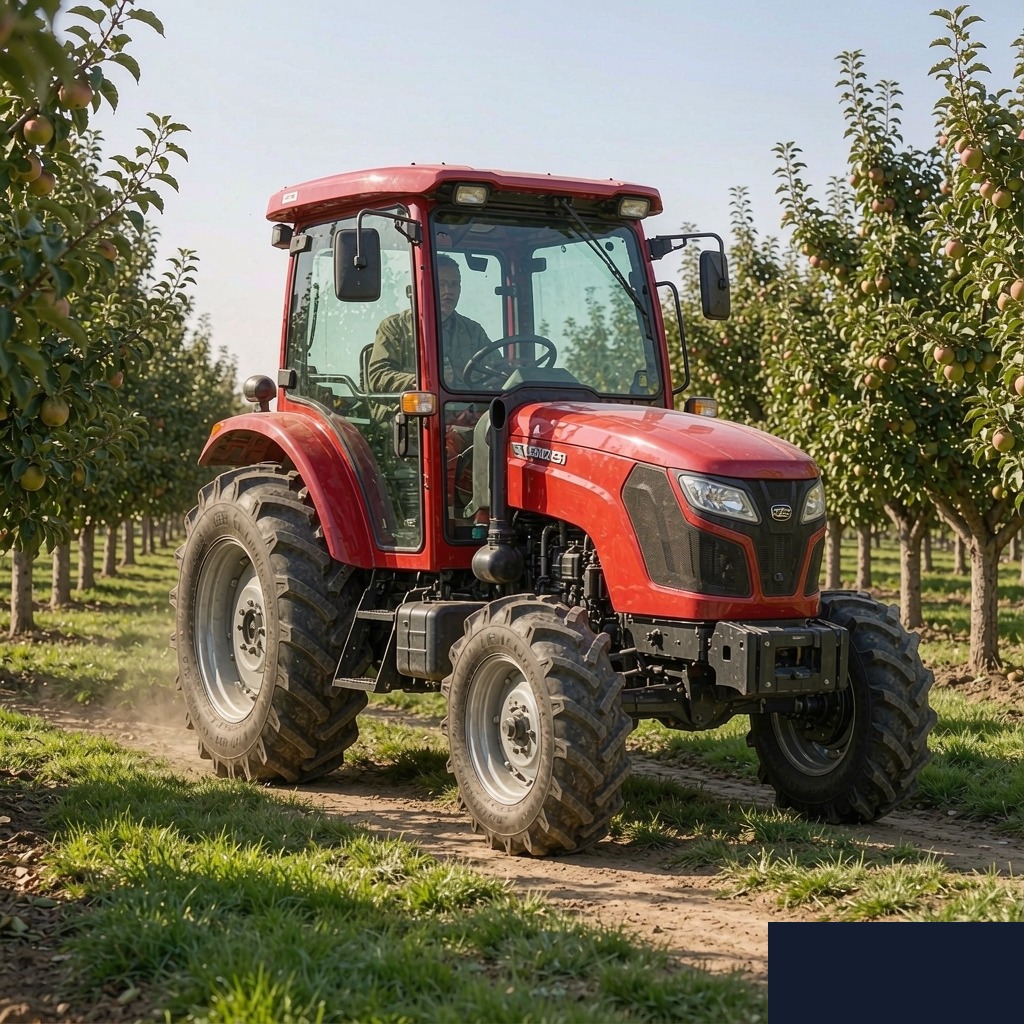
Most small and mid-sized farms overbuy horsepower. The 70–120HP 4WD class now holds the largest share of the global tractor market — 42.8% of engine-power segment share in 2026 — precisely because it covers rotary tillage, loader work, haulage, orchard management, and light contracting without the fuel burn, transport cost, or service complexity of 160HP+ machines. This 70–120HP farm tractor buying guide walks you through matching horsepower to acreage and crop type, comparing LUYRN’s five in-stock 4WD models (704, NLX754, LX904, LY1204, and the 1204 orchard tractor), sizing implements, and budgeting a five-year total cost of ownership — so you can place a factory-direct order that fits your land, not a brochure.
Why 70–120HP Is the Sweet Spot for Small and Mid-Sized Farms
The global agricultural tractor market is projected at roughly USD 93.7 billion in 2026, growing at about 6% CAGR through 2033, and the growth is not happening at the top of the horsepower range. Industry analyses consistently identify the 40–120HP utility band as the segment with the highest penetration growth, driven by family farms, horticultural bases, and scattered smallholdings across emerging and developed markets alike. Orchard and compact tractors are growing even faster than the market average, thanks to expanding fruit and vegetable cultivation and persistent labor shortages in high-value crops.
Three practical reasons explain why B2B buyers concentrate here:
- Versatility per dollar. A 70–120HP 4WD tractor can plow, till, mow, spray, haul, and run a front-end loader or backhoe — one chassis replacing three single-purpose machines.
- Serviceability. Gear-driven, mechanically simple tractors still command roughly 73% of units sold in 2026. In regions with limited dealer networks, a design any competent mechanic can rebuild beats a tech-heavy flagship.
- Running economics. A 90HP diesel burns a fraction of what a 200HP unit consumes per hour, and mid-range tractors typically stay in service 8–15 years — a long amortization window that suits dealer and tender buyers as much as farm owners.
If your operation routinely pulls six-furrow ploughs or runs 30-tonne grain carts, step up to our 160–200HP Stage V tractor buying guide instead. For everyone else, read on.
Matching Horsepower to Farm Size and Crop Type
The single most reliable rule in tractor selection: buy the smallest tractor that comfortably handles your heaviest regular task, then check that it still covers the daily work. An oversized tractor wastes diesel every hour; an undersized one stalls at the headland and shortens implement life. Use the table below to place yourself before comparing models.
| Farm Situation | Recommended HP Class | LUYRN Match | Why It Fits |
|---|---|---|---|
| Smallholding or market garden under 5 ha; greenhouse and nursery work | 70–75HP | 704 70HP 4WD / NLX754 75HP 4WD | Lowest acquisition cost; enough reserve for a rotary tiller, trailer, and front loader without paying for unused draft power |
| Mixed farm 5–20 ha combining tillage, loader work, and haulage | 90HP | LX904 90HP 4WD | 540/1000 rpm PTO covers light and heavy implements; loader, backhoe, and hay-tool ready |
| 20–50 ha broadacre, contractor, or tender fleets | 120HP | LY1204 120HP 4WD | Reinforced plus-size chassis for heavy ploughing and flood/drought dual-season rotation |
| Orchards, vineyards, and greenhouse rows with tight spacing | 120HP (narrow chassis) | 1204 120HP Orchard Tractor | Maneuverable specialty layout built for tilling, ditching, sowing, and weeding between rows |
Two calibrations matter more than the headline HP figure. First, PTO power is roughly 80–85% of engine power — a 90HP tractor delivers about 75HP at the shaft, so match implements to PTO ratings, not the sticker. Second, 4WD is non-negotiable for wet-season traction and loader work: 4WD variants dominate 2026 sales for good reason, and every model in LUYRN’s range is 4WD as standard.
LUYRN 70–120HP 4WD Lineup: 2026 Model Comparison
LUYRN ships five factory-direct 4WD models across this class, all CE/ISO-certified production with OEM/ODM options and export documentation. Final engine brand, transmission ratios, and emission tier are confirmed at order — always get the confirmed configuration sheet in writing before paying a deposit.
| Model | Power / Drive | Hitch & PTO | Character | Best For |
|---|---|---|---|---|
| 704 | 70HP · 4WD | Category I/II three-point, rear PTO, ROPS or cabin optional | Multifunctional utility, manual gearbox, broad attachment list | Budget utility for farms, dealers, and tender projects |
| NLX754 | 75HP · 4WD | Rear PTO + three-point hitch, cabin optional | All-purpose strong-power build for daily field utility | Rotary tilling, cultivated land, soil-pushing support |
| LX904 | 90HP · 4WD | Dual-speed 540/1000 rpm PTO, category rear three-point, multiple hydraulic outlets | “Shed King” multi-use chassis, tillage to hay in one machine | Rotary tillage, ditching, flood/drought dual-use, loader/backhoe and baler work |
| LY1204 | 120HP · 4WD | Rotary-plough-ready, reinforced plus-size layout | Plus-sized heavy-draft tractor for larger working loads | Heavy ploughing and mixed-soil flood/drought seasons |
| 1204 Orchard | 120HP · 4WD | Specialty maneuverable chassis for confined work | Greenhouse/orchard multi-use: tilling, ditching, sowing, weeding | Narrow rows, greenhouse aisles, high-value perennial crops |
For buyers whose acreage sits right at the top of this band, the natural upgrade path is the LX1604 160HP Stage V, with the LX2004-M and LMA2004 covering the 200HP tier — the same factory, the same export process.
Orchard, Vineyard, and Greenhouse Work: Why Chassis Matters as Much as HP
Two 120HP tractors with the same engine can be completely different machines in a fruit row. Specialty orchard and vineyard tractors trade frame bulk for a reduced track width, a lower profile, and a tighter turning radius, so the machine passes between trees without scraping trunks or crushing roots. Industry guidance for high-value crops is specific:
- Overall width: choose a tractor at least 15–30 cm narrower than your tightest row spacing. Vineyard rows commonly run 1.8–2.4 m apart, which is why dedicated orchard units measure roughly 1.3–1.55 m across.
- Ground clearance: a minimum of about 30 cm protects the underside over ridges and cover crops.
- Lift capacity: orchard sprayers and cultivation tools typically need 680–1,360 kg of three-point lift.
- Turning radius: tight headlands cut compaction and turnaround time; this is where specialty chassis earn their premium.
The 1204 orchard tractor was engineered for exactly this brief: rotary tilling, ditching, sowing, and weeding in narrower working environments, from greenhouse aisles to perennial fruit blocks. Standard farm tractors like the LY1204 will out-pull it in open draft work but cannot physically enter a 2-meter row. If your operation combines both worlds — open field plus orchard blocks — the honest answer is often one of each, or one 90HP multi-use chassis for the field and a compact machine for the rows. For drainage and trenching that a tractor cannot reach, pair the fleet with a compact digger — see our 3-ton mini excavator buying guide.
Implement Matching: Loaders, Tillers, and PTO-Driven Tools
A tractor is only as productive as the tools behind it. Getting the implement package right at order time saves a second freight cycle and guarantees compatibility:
- Front-end loader: the most requested attachment for this class. Confirm hydraulic outlet count and pump flow with the supplier; the LX904 ships with multiple hydraulic outlets for loader, backhoe, and trailer circuits.
- Rotary tiller: match tiller width to tractor weight and PTO power. LUYRN’s 704 and LX904 are tiller-ready as ordered configurations.
- PTO speed: dual-speed 540/1000 rpm doubles your implement universe — 540 rpm for mowers, sprayers, and light tillage; 1000 rpm for heavy tillers and balers. Add a 10–15% PTO power buffer over your most demanding implement’s rating.
- Hitch category: Category I/II three-point covers most 70–120HP implements; confirm which category your existing tools use before ordering a Category II-only machine.
- Backhoe and trailer: popular add-ons for dealer stock and contracting fleets; bundling them into the same container as the tractor cuts unit freight cost substantially.
For the full framework on spec sheets, supplier audits, and tender documentation across the wider range, our 70–200HP farm tractor procurement guide goes deeper.
Fuel, Financing, and 5-Year TCO for Mid-Range Tractors
Compact and mid-range utility tractors typically retail between USD 8,000 and 35,000 depending on horsepower, transmission, cabin, and emission tier — and factory-direct Chinese export pricing sits toward the lower half of that band. Sticker price, however, is only the first line of the budget. Structure your five-year view around these lines:
| Cost Line | What to Check Before Ordering | LUYRN Support |
|---|---|---|
| Acquisition | Confirmed configuration sheet: engine brand, gearbox ratios, emission tier for your market, cabin vs ROPS | OEM/ODM configuration, written spec confirmation, bulk pricing |
| Fuel | Duty-cycle hours × rated consumption; right-sized HP avoids paying to haul unburned reserve | Model matching to duty cycle before quotation |
| Service & parts | Filter/fuel-injection parts availability locally; mechanic-friendly gear drive vs electronics | Spare-parts guidance and packing documentation with every export |
| Implements & freight | Bundle tiller/loader/trailer into the same shipment; check port and inland legs separately | Consolidated packing and export documents |
| Resale value | Service records, emission compliance for the resale market, tire and hitch wear | CE/ISO-certified production supporting secondary-market acceptance |
Two 2026-specific notes. First, financing: with buyer sentiment favoring value-driven purchases, many dealers and tender projects now negotiate payment terms or staged deliveries as aggressively as unit price — factory-direct exporters can often structure this. Second, subsidies: India, Brazil, and several Sub-Saharan and Asian programs are actively funding mechanization in exactly this horsepower band; confirming which certification paperwork your local program requires before ordering (not after arrival) is the difference between a claimable machine and a stranded one.
Import Checklist: Specifying and Inspecting Your Order
Whether you buy one unit or a container, hold every supplier to the same gate checks:
- Written configuration: engine brand and model, PTO speeds, hitch category, tire specification, and cabin/ROPS choice — itemized, not “70HP tractor, 4WD.”
- Emission tier for your destination: Stage V, EPA Tier 4, or local equivalents; a non-compliant engine can cost more in penalties than the tractor saved.
- Pre-shipment inspection: photos or third-party inspection of the actual serial-numbered unit, cold-start video, and PTO/hydraulic function test.
- Spare-parts package: first-service filters, common wear parts, and a parts manual — order these with the machine, not after it fails at planting season.
- Documentation set: commercial invoice, packing list, certificate of origin, CE/ISO certificates, and fumigation/disinfection certificates as required by your port.
Frequently Asked Questions
Is a 70HP tractor enough for a 10-hectare mixed farm?
For most 5–20 hectare mixed operations, a 70–90HP 4WD tractor with a front loader and rotary tiller covers ploughing, tillage, haulage, and mowing comfortably. Step to 120HP only if your heaviest regular task — deep ploughing heavy clay, large balers, or broadacre contract work — actually demands the draft. Buying the smallest tractor that handles your heaviest regular task is the core rule; every extra horsepower you don’t use is diesel you still pay for.
What is the difference between the LY1204 and the 1204 orchard tractor when both are 120HP?
Same power class, different chassis mission. The LY1204 is a reinforced plus-size tractor built for heavy draft — deep ploughing, flood/drought dual-season work, larger working loads. The 1204 uses a maneuverable specialty layout for confined spaces: greenhouse aisles and orchard rows where tilling, ditching, sowing, and weeding happen between obstacles. Choose by where the machine will physically work, not by the HP number.
Can one tractor run both a front-end loader and a rear-mounted tiller?
Yes — this is the standard configuration for this class. The loader runs off hydraulic remote outlets; the tiller runs off the rear PTO and three-point hitch. Confirm at order that the tractor has multiple hydraulic outlets (the LX904 does) and, ideally, dual-speed 540/1000 rpm PTO so lighter and heavier implements both match.
Which implements should I order together with the tractor?
The most common bundle for this class: rotary tiller, front-end loader, and trailer, with a backhoe or plough added by job type. Bundling into the same shipment consolidates freight and guarantees factory-matched hitch categories and PTO speeds. Ask LUYRN for a matched package quotation against your task list rather than ordering implements piecemeal later.
Do LUYRN tractors meet CE and ISO requirements?
LUYRN tractors are produced under CE and ISO-certified processes, and every export includes documentation support for destination-market registration. Emission compliance is configuration-specific: confirm your target market’s tier (e.g., Stage V or EPA Tier 4) when requesting a quotation so the confirmed build sheet matches import requirements.
Request a Quote from LUYRN
Send us your acreage, primary crops, row spacing, and the tasks you need covered, and our team will recommend the right 70–120HP configuration with a matched implement package and FOB/CIF quotation. Email info@luyrn.com with your duty cycle and destination port — most inquiries receive a confirmed-configuration proposal with export pricing within one business day.