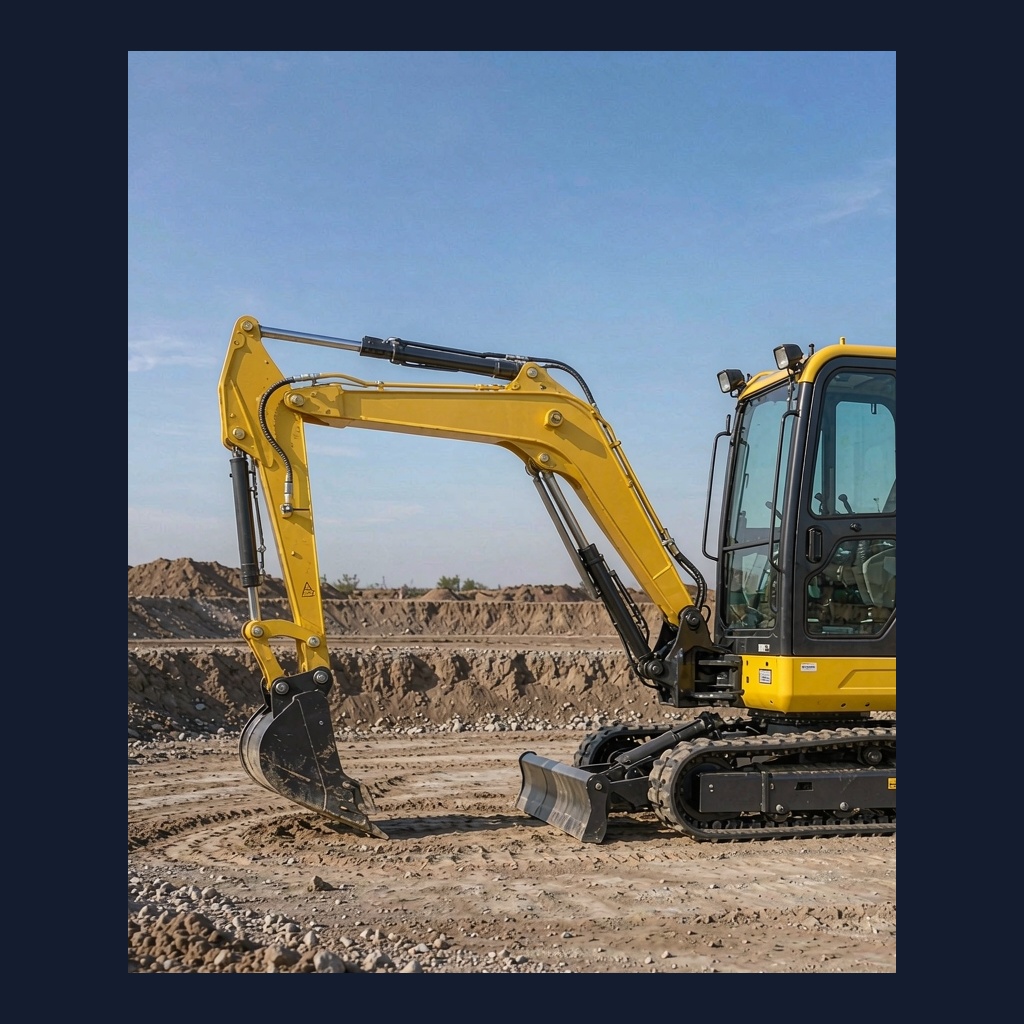
The 3-ton mini excavator has become the default workhorse for contractors who split their time between urban utility trenches, residential landscaping, and tight-access commercial lots. In 2026, industry data shows the 3-ton class capturing roughly half of all compact excavator demand, because it balances digging depth, breakout force, and trailer mobility better than sub-2-ton micro units or heavier 5-ton machines.
If you are sourcing a 3-ton mini excavator for a rental fleet, municipal works department, or landscaping business, this guide walks through the specs that actually matter, compares the LUYRN HL30, HL35, HL35U zero-tail, and 3-ton mini crawler models, and gives a practical total-cost-of-ownership framework for B2B buyers.
Unlike the 6.5–26-ton crawler excavator class covered in our earlier guide, the 3-ton band is defined by access limits rather than raw earthmoving volume. The right buying decision starts with the gate width, soil type, and attachment mix, not horsepower alone.
Why the 3-Ton Class Dominates Urban Utility & Landscaping in 2026
Several market forces are pushing procurement teams toward the 3-ton band:
- Urban density: Full-size excavators cannot reach many residential backyards, narrow alleys, or pedestrian zones. A 3-ton machine with a 1.5 m width passes through most gates and sidewalks.
- Transport economics: Most 3-ton units can be hauled on a light trailer pulled by a standard pickup, cutting mobilization cost compared to 6-ton machines that need heavy-low loaders.
- Fuel efficiency: Representative 3-ton diesel mini excavators consume 1.3–2.0 L/h under normal load, roughly 20% less than comparable 5-ton models.
- Attachment versatility: Auxiliary hydraulics support breakers, augers, grapples, compactors, and tilt buckets, so one base unit replaces multiple dedicated machines.
For buyers comparing the 1-ton vs 3.5-ton decision, the 3-ton class is the practical middle ground: more power than a micro unit, easier to transport than a mid-size compact. Rental yards also favor the class because utilization stays high across seasons—summer landscaping, autumn trenching, and winter demolition all keep a 3-ton machine billable.
LUYRN 3-Ton Mini Excavator Range at a Glance
LUYRN stocks four models in the 3-ton compact band. The table below compares the dimensions, digging performance, and tail-swing type most relevant for urban and landscaping buyers.
| Model | Operating Weight | Body Width | Bucket Capacity | Tail Swing | Best Fit |
|---|---|---|---|---|---|
| HL30 | 2.4 t | 1,350 mm | 0.10 m³ | Conventional | Landscaping, trenching, rental fleets |
| 3-Ton Mini Crawler | 3.0 t | On request | On request | Conventional | General urban utility, flexible OEM specs |
| HL35 | 2.5 t | 1,350 mm | 0.10 m³ | Conventional | Light construction, grading, footpath work |
| HL35U | 3.8 t | 1,500 mm | 0.11 m³ | Zero tail | Confined sites, walls, residential, urban rehab |
Specifications are indicative. Confirm final engine, hydraulic, and undercarriage configuration with LUYRN before ordering.
Zero Tail Swing vs. Conventional Tail: Which Layout for Your Job Site?
The biggest single decision in the 3-ton class is tail-swing design. Each layout trades off workspace safety, digging stability, and acquisition price.
| Tail Type | How It Works | Advantages | Best Applications |
|---|---|---|---|
| Zero tail swing | Rear stays within track width during rotation | Safest near walls and pedestrians; less repositioning in tight lots | Urban rehab, residential backyards, trenching along buildings |
| Compact / short radius | Minimal overhang beyond tracks | Better lift stability than ZTS; still fits narrow zones | Mixed urban lots, small commercial pads |
| Conventional | Counterweight extends behind tracks | Lowest price per kg of lift; best dig geometry | Open ground, landscaping, agricultural ditches |
For buyers working within 300 mm of a vertical obstruction, zero tail swing is usually worth the premium. The HL35U is LUYRN’s zero-tail option in this class, with a wider 1,500 mm body and heavier 3.8 t operating weight that improves stability while still fitting through tight access points.
Specs That Matter for Urban & Landscaping Work
Beyond tail swing, prioritize these five specification groups when sourcing a 3-ton mini excavator:
- Digging depth and reach: 3-ton machines typically achieve 2.3–3.0 m dig depth and 4.5–5.1 m digging radius. Choose the longer reach only if you regularly dig over obstacles; longer arms reduce breakout force.
- Bucket breakout force: Expect 14–22 kN in the 3-ton band. Higher breakout force matters for clay, compacted soil, and small rock.
- Ground pressure: Rubber tracks on a 3-ton unit produce roughly 0.35–0.40 kg/cm², low enough for finished lawns and paved surfaces without excessive damage.
- Auxiliary hydraulic flow: Single aux is standard; check flow rate (typically 40–65 L/min) and pressure for breaker, auger, or grapple compatibility.
- Engine emission tier: For EU, UK, or regulated North American markets, confirm Tier 4 Final / EU Stage V documentation. For less regulated regions, Tier 3 or China IV configurations may be acceptable and lower cost.
For a deeper dive into hydraulic architecture, see the LUYRN mini excavator hydraulic system guide.
Attachments That Turn a 3-Ton Mini into a Multi-Tool Fleet
One of the strongest arguments for the 3-ton class is attachment density. A single base machine can handle trenching, demolition, drilling, grading, and material handling by swapping tools. Common pairings include:
- Trenching bucket: 300–500 mm width for utility lines and irrigation.
- Hydraulic breaker: Match impact energy to the 3-ton carrier; over-sized breakers damage boom geometry.
- Auger drive: Ideal for fence posts, tree planting, and sign foundations.
- Compaction wheel / plate: Backfill and soil compaction without a separate roller.
- Grading blade / tilt bucket: Finish grading and slope work for landscaping.
Before ordering, confirm quick-hitch pin dimensions and auxiliary hydraulic flow requirements. LUYRN can bundle attachments with the HL30, HL35, or HL35U as part of an OEM project quote.
2026 TCO Snapshot: Fuel, Maintenance, Transport & Resale
A 3-ton mini excavator is usually the cheapest compact excavator to own on a per-hour basis, but the spread between models depends on fuel, tracks, and attachment use. The table below summarizes a 5-year ownership model for a 3-ton unit running 800 hours per year.
| Cost Item | Typical Range | Notes |
|---|---|---|
| Acquisition (ex-works) | $20,000–$35,000 | Zero-tail and Tier 4F/Stage V configurations at the upper end |
| Fuel (diesel) | 1.3–2.0 L/h | Assumes 60% average load; auto-idle reduces consumption |
| Rubber tracks | $800–$1,500 / set | Life 1,200–2,000 h on abrasive ground |
| Engine & hydraulic service | $800–$1,500 / year | Oil, filters, grease; longer intervals on modern engines |
| Transport (per move) | $50–$150 | Light trailer vs heavy-low loader |
| 5-year resale value | 40–55% of purchase price | Higher for CE/Stage V units with documented maintenance |
Rubber tracks, proper operator training, and documented service history are the three biggest levers for keeping 5-year TCO low. A 3-ton machine that stays on a light trailer and avoids steel-track ground damage is usually profitable for rental fleets within 18–30 months.
Buyers should also budget for attachment wear parts. Breaker chisels, auger teeth, and bucket cutting edges are consumables that can add $500–$2,000 per year depending on application mix. Including a starter wear-part package in the original purchase locks in pricing and avoids downtime while local suppliers source items.
CE/ISO Compliance & Supplier Checklist for B2B Buyers
When importing 3-ton mini excavators in 2026, compliance documentation is as important as the machine specification. Request the following before finalizing an order:
- CE Declaration of Conformity and ISO 9001 factory certificate
- Engine emission certificate (Stage V, Tier 4 Final, or China IV as applicable)
- ROPS/FOPS cab or canopy certification
- Hydraulic hose pressure-test reports and burst ratings
- Spare-parts price list and recommended stock for the first 2,000 hours
- Warranty terms for engine, hydraulic pump, and structural welds
For a broader compliance framework, see the LUYRN CE & ISO standards checklist.
Frequently Asked Questions
What jobs suit a 3-ton mini excavator best?
Utility trenching, residential landscaping, municipal footpath repair, pool excavation, light demolition, and agricultural ditching. The 3-ton class is the market sweet spot for work that needs more power than a 1-ton micro but lighter transport than a 5-ton unit.
Is zero tail swing worth the extra cost?
For work inside 300 mm of walls, fences, or pedestrians, yes. Zero tail swing reduces collision risk and repositioning time. For open ground, a conventional-tail machine such as the HL30 or HL35 gives better lift geometry at a lower price.
How deep can a 3-ton mini excavator dig?
Most 3-ton units dig 2.3–3.0 m. Long-arm options add 150–300 mm but reduce breakout force. Match dig depth to your typical trench specification rather than buying the longest arm available.
What fuel consumption should I expect?
Representative 3-ton diesel mini excavators use 1.3–2.0 L/h under mixed load. Auto-idle, efficient hydraulics, and operator training can reduce consumption by 10–15%.
Can LUYRN customize a 3-ton mini excavator for my market?
Yes. LUYRN supports OEM/ODM configurations including engine brand, emission tier, canopy/cab style, auxiliary hydraulic circuits, and attachment packages. Contact info@luyrn.com with your target market and annual volume for a project quote.
Get a 24-Hour Quote from LUYRN
The 3-ton mini excavator is the most versatile compact class for urban and landscaping contractors in 2026. Whether you need the conventional HL30 and HL35 or the tight-access HL35U zero-tail, LUYRN supplies CE/ISO-certified machines with OEM support and global logistics.
Email info@luyrn.com or request a quote through the product page. Most B2B quotes are returned within 24 hours with full specs, lead time, and shipping options.