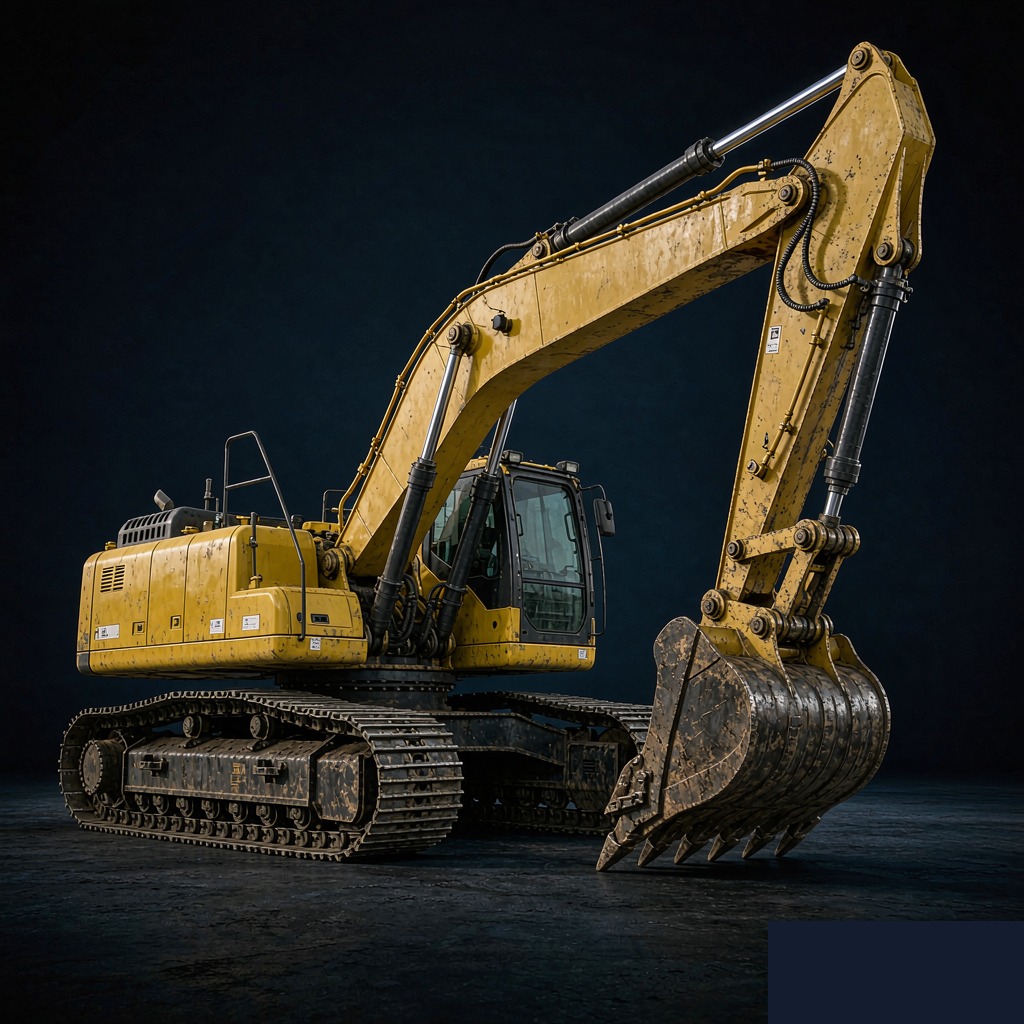
Quick Answer: Which Crawler Excavator Class Should You Buy in 2026?
For most contractors and equipment dealers, the right answer comes down to three brackets: 6.5–7.5 ton machines for utilities and urban work, 13.5 ton as the do-everything midi class, and 20–26 ton crawlers for production earthmoving and truck loading. Pick the wrong bracket and you either pay to transport capacity you never use, or you burn out an undersized machine on work it was never designed for. This guide walks through the full 6.5–26 ton range using real specification data from the LUYRN HL series — models HL65, HL75, HL135, HL200, HL225 and HL260 — together with current industry benchmarks on fuel burn, emissions compliance, total cost of ownership and supplier due diligence.
Match the Tonnage Class to the Job Before You Compare Prices
The single most expensive mistake in excavator procurement is sizing the machine to the budget instead of the work. A crawler excavator earns money through its bucket, and every tonnage class is optimized for a different bucket workload:
- 6.5–7.5 ton (HL65 / HL75). The utility class. Urban infill projects, landscaping, sewer and water line trenches, footings for small structures, and road maintenance. These machines dig with 0.23–0.28 m³ buckets, travel between sites on a standard tag trailer, and put enough ground pressure into soft soil without wrecking finished surfaces. A 6.5-ton machine with a 2,000 mm transport width moves without escort vehicles in most jurisdictions.
- 13.5 ton (HL135). The contract-floor midi class. Housing developments, drainage networks, light demolition, bulk digging in confined subdivisions. With a 0.53–0.64 m³ bucket and 100 kN of bucket digging force, it loads 10-ton trucks at a rate the 7-ton class cannot match, while still shipping on a mid-size lowbed.
- 20–26 ton (HL200 / HL225 / HL260). The production class. Infrastructure earthworks, quarry load-out, bulk excavation, heavy pipe-laying and demolition support. These machines swing 1.0–1.2 m³ buckets with up to 172 kN of bucket force and cycle fast enough to load 20–30 ton haul trucks 4–5 passes at a time.
If your work is mostly indoors, in backyards or on finished slabs, you are actually shopping in the mini class — see our comparison of 1-ton vs 3.5-ton mini excavators before dismissing smaller machines entirely.
The LUYRN 6.5–26 Ton Crawler Lineup at a Glance
LUYRN exports the HL series crawler excavators from 6.5 to 26 tons, all supplied with CE documentation and OEM configuration options. The table below summarizes the factory specification data buyers should anchor their shortlist on:
| Model | Operating Weight | Bucket Capacity | Max Bucket Force | Fuel Tank | Typical Duty |
|---|---|---|---|---|---|
| HL65 (6.5 t) | 6.6 t | 0.23 m³ | — | — | Utilities, landscaping, urban trenches |
| HL75 (7.5 t) | ~7.5 t | 0.28 m³ | 56 kN | — | Road works, drainage, site prep |
| HL135 (13.5 t) | 13 t | 0.53–0.64 m³ | 100 kN | 247 L | Residential earthworks, light demolition |
| HL200 (20 t) | 21.8 t | 1.0 m³ | 157 kN | 420 L | Production digging, truck loading |
| HL225 (22.5 t) | ~22.5 t | 1.1 m³ | 140 kN | — | Infrastructure, bulk excavation |
| HL260 (26 t) | 24 t | 1.2 m³ | 172 kN | 420 L | Quarry support, heavy earthmoving |
Two specifications deserve special attention when you compare these models. First, fuel tank volume against shift length: the HL200 and HL260 carry 420 L, enough for a full production shift without refueling, while the HL135’s 247 L tank still covers a standard 8–10 hour utility shift comfortably. Second, bucket digging force against material: 56 kN on the HL75 handles soil and clay, but rock and frost-ripped ground belong to the 100–172 kN machines. Ask any supplier for the force figures at the bucket, not at the cylinder — cylinder force multiplied by linkage ratios is what actually digs.
Fuel Burn and Emissions: The Numbers That Decide Your Five-Year Cost
Purchase price is a one-time number; fuel is an annuity. Current 2026 industry benchmarks put consumption at roughly 7–9 L/h for the 6-ton class and 10–14 L/h for a 20-ton crawler running at around 60% load factor — the honest midpoint between light trenching and full-throttle bulk work. On a 2,000-hour annual utilization, that 20-ton machine consumes 20,000–28,000 liters of diesel per year, which at typical retail diesel prices is a five-figure operating line before a single filter is changed. A 2 L/h difference between two competing 20-ton models is therefore worth 20,000 liters over five years — often more than the discount that won the deal.
Emissions tier is now a fuel specification in disguise. Field data across current-generation platforms shows Stage V / Tier 4 Final machines consuming 12–15% less fuel than Stage IIIA units on identical duty cycles, which typically pays back the emissions-tier price premium within 3,000–4,000 operating hours — before counting the access that compliant machines get to regulated city tenders in the EU, UK and parts of North America. When you source from China, confirm in writing which emission standard the engine is certified to and whether the aftertreatment (DOC/DPF/SCR) hardware is actually fitted, not just quoted.
Scheduled maintenance intervals complete the running-cost picture. Current industry norms publish 500-hour engine oil changes, 1,000-hour hydraulic oil service (extendable to 2,000 hours on modern platforms), and swing bearing greasing at 500-hour intervals. Demand the full service schedule in writing before you order, and check that filters, final drive oil and sensors are items you can actually source in your market.
Five Spec-Sheet Traps That Cost Buyers Real Money
Most rejected-spec post-mortems trace back to the same handful of errors. Build your purchase order around these five checks:
- Oversizing the bucket for the boom geometry. A bigger bucket looks like free productivity, but an oversized bucket loads the swing bearing and front linkage beyond design limits and can cut machine life by 20–30%. Match bucket capacity to the factory-recommended range — 1.0 m³ on the HL200, 1.2 m³ on the HL260 — and resist tempting upgrades beyond it.
- Underspecifying auxiliary hydraulic flow for attachments. If a breaker, compactor or shear will run even 40% of your hours, the auxiliary circuit flow and pressure must be engineered for it on day one. Our hydraulic breaker procurement guide explains how to match breaker class to carrier weight, and our attachments buyer’s guide covers quick-hitch and line compatibility.
- Ignoring transport width and weight. The HL225 measures 2,980 mm across — over-width for road transport in most countries, requiring permits or a lowbed. A 20-ton machine ships disassembled (boom off, often cab off) in flat-rack containers, which is standard practice for export units. Model the mobilization cost before the purchase, not after; our guide to importing excavators from China covers packing, duties and port logistics in detail.
- Comparing operating weight without checking the counterweight configuration. “20-ton class” machines range from 19.5 to 22 tons depending on counterweight, track gauge and arm length. Stability, lift capacity at radius and even road-legal transport all shift with those choices, so compare machines at the same configuration before comparing prices.
- Buying on price with no documentation trail. Documented 5–8-year-old 20-ton excavators typically retain 45–55% of original value on resale, while units without service records fall well below that band regardless of brand. Insist on a factory test report, hour-meter reading at handover, and a serial-numbered parts book — they are resale assets.
Worked Example: Five-Year Cost of a 20-Ton Crawler Excavator
To make the trade-offs concrete, here is a simplified five-year total-cost model for one HL200-class machine at 2,000 hours per year, using mid-range industry benchmark assumptions (adjust fuel price and labor to your market):
| Cost Line | Assumption | 5-Year Estimate |
|---|---|---|
| Fuel | 12 L/h × 2,000 h/yr × 5 yr = 120,000 L | $96,000–$150,000 |
| Scheduled maintenance | 500 h oil service + 1,000 h hydraulic service cycles | $18,000–$30,000 |
| Undercarriage wear | Track renewal at ~3,000–4,000 h; rollers, idlers | $15,000–$25,000 |
| GET and attachment wear | Teeth, side cutters, pins and bushings | $8,000–$15,000 |
| Resale recovery (offset) | 50% retention × realistic resale value at 10,000 h | −(30%–50% of unit price) |
The takeaway is not the absolute numbers — it is the ratio. On a machine of this class, five years of diesel alone can exceed the purchase price. That is why a 12–15% fuel-efficiency advantage, a correctly sized bucket and a documented service history matter more per dollar than the last 3% off the invoice.
Supplier Due-Diligence Checklist Before You Wire the Deposit
Whether you buy from LUYRN or any other exporter, run every candidate through the same gate before money moves:
- Compliance documents: CE declaration of conformity, ISO 9001 factory certification, and engine emission certificate for your destination market (see our CE & ISO standards comparison for buyers).
- Load test video: a current video of your actual serial-numbered machine cycling under load, with the hour meter and boom/arm/bucket movements visible.
- Steel and weld specification: boom/arm material grade and weld procedure, especially if you work in abrasion-heavy or demolition duty.
- Parts availability commitment: guaranteed 12-month parts supply, filter kit included with the machine, and a named parts contact with response-time commitment.
- Warranty terms in writing: duration, coverage (engine, hydraulics, structure), and the claim process — not a verbal “one year warranty.”
- Export packing plan: flat-rack versus RO-RO assignment, silica gel and wrap protection, and photos before container closure.
- References: two buyers in a comparable market you can call, ideally running the same model in similar duty.
Frequently Asked Questions
How much fuel does a 20-ton excavator use per hour?
Plan on 10–14 L/h at a realistic 60% load factor for a modern 20-ton crawler; light duty can drop below 10 L/h and continuous bulk digging pushes toward the top of the band. At 2,000 hours per year, budget 20,000–28,000 liters annually and use that number to compare competing machines — a 2 L/h saving is worth roughly $8,000–$12,000 over five years at 2026 retail diesel prices.
What can a 6.5-ton excavator realistically do?
A 6.5-ton machine like the HL65 digs 4-meter-class trenches with a 0.23 m³ bucket, handles footings, landscaping and utility work, and tows behind a common tag trailer at 2,000 mm transport width. It is the right class for contractors doing distributed small jobs — not for sustained bulk excavation, where cycle economics favor the 13.5-ton and up.
Can a 20-ton excavator be shipped in a container?
Yes — standard export practice removes the boom (and often the cab) and ships the machine on one or two 40-foot flat racks, with the boom as separate breakbulk. RO-RO is the alternative where port facilities allow. This disassembly is designed for, not a workaround, and reassembly at destination is a 4–8 hour job for a technician. Allow roughly 30–45 days port-to-port from Chinese ports to most destinations.
What is the difference between the HL200, HL225 and HL260?
They bracket the 20-ton production class. The HL200 runs 21.8 t operating weight with a 1.0 m³ bucket and 157 kN bucket force — the versatile fleet workhorse. The HL225 steps up to a 1.1 m³ bucket with a 99 kN arm force for faster trench profiles. The HL260 at 24 t and 172 kN carries a 1.2 m³ bucket and a 3,050 mm arm for quarry support and heavy bulk work. Choose by your heaviest routine bucket load, not your peak one.
Get a 6.5–26 Ton Excavator Quotation
LUYRN supplies the full HL series crawler excavator range with CE documentation, export packing and OEM configuration for dealers, rental fleets and construction contractors worldwide. Email info@luyrn.com with your target tonnage class, primary material, planned annual hours and destination port, and our team will come back with specification sheets, configuration options and an export quotation — typically within one business day.