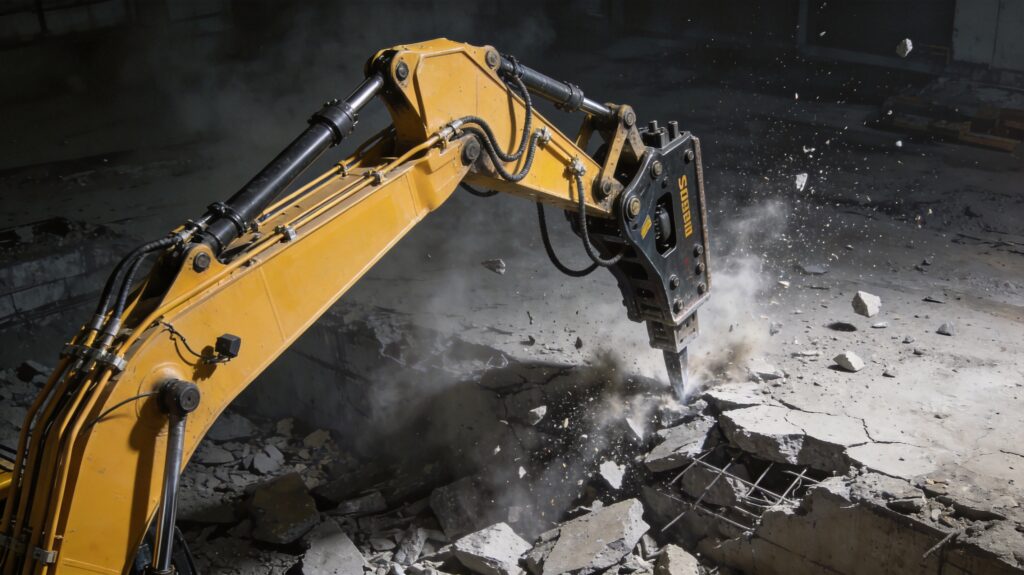
Hydraulic breakers are among the highest-utilization attachments on any excavation or demolition fleet. A mismatched breaker costs you 30–40% in lost impact energy, and a non-compliant unit can be detained at EU customs or void project insurance. This guide walks equipment distributors, rental fleets, and contractors through the procurement process from specification to shipment.
Market Snapshot for 2026
The global machine-mounted hydraulic breaker market reached USD 2.85 billion in 2025 and is projected to hit USD 3.03 billion in 2026, growing at a CAGR of 5.85% through 2032 (Persistence Market Research). Construction accounts for 57% of demand, mining contributes 29%, and the remaining 14% comes from quarrying and recycling (Global Growth Insights). Asia-Pacific holds a 42% share, driven by a 35% increase in infrastructure spending. For buyers, this means a growing supplier base—but also wider quality variance across OEM and white-label manufacturers.
Matching Breaker Class to Your Carrier
The single most common procurement error is selecting a breaker by tool diameter alone. Three parameters must align with the host machine:
| Breaker Class | Carrier Weight | Tool Diameter | Typical Application |
|---|---|---|---|
| Mini / Light | 0.8–4 ton | 40–70 mm | Indoor demolition, landscaping |
| Medium | 4–12 ton | 70–100 mm | Road breaking, foundation work |
| Heavy | 12–30 ton | 100–140 mm | Quarry, primary rock breaking |
| Extra Heavy | 30+ ton | 140–200 mm | Mining, mass excavation |
The breaker-to-carrier weight ratio should fall between 8% and 15% of the excavator’s operating weight. Below 8%, the carrier cannot provide sufficient down-force; above 15%, the boom and arm structure face accelerated fatigue. Hydraulic flow requirements are equally critical: a medium-class breaker needs 50–90 L/min at 120–170 bar operating pressure. Mismatched flow results in 20–30% lower blow frequency and overheats the carrier’s hydraulic system within 4–6 hours of continuous operation. Browse excavator-compatible breakers and attachments matched to 1.8–8 ton carriers.
CE and ISO Compliance: What Buyers Must Verify
For the EU market, hydraulic breakers must carry CE marking under the Machinery Directive 2006/42/EC. This involves three additional directives depending on configuration:
- Noise Emission (2000/14/EC): Sound power level must not exceed 110 dB(A); compliant units typically measure 105–108 dB(A) at 7 meters.
- EMC Directive (2014/30/EU): Required only if the breaker includes electronic control or auto-lubrication systems.
- Pressure Equipment Directive (2014/68/EU): Applies to accumulators and hydraulic circuits above 0.5 bar.
On the ISO side, ISO 9001 quality management is the baseline—80% of B2B buyers rank it as a non-negotiable supplier qualification (WN Hydraulics). ISO 14001 environmental management is increasingly required for public infrastructure tenders in the EU and GCC countries. Request the following documents before placing a deposit:
- EU Declaration of Conformity (DoC) with Notified Body number
- Technical file per Annex VII of 2006/42/EC
- Hydraulic circuit pressure test report at 1.5× working pressure
- Noise measurement report per EN ISO 3744
- EU Authorized Representative contact details (mandatory for non-EU manufacturers)
Self-issued CE marks without Notified Body involvement are a known compliance trap. LUYRN breakers ship with full CE and ISO 9001 documentation and a 12-month warranty.
Procurement Workflow: MOQ 1 to Bulk Shipment
LUYRN supports a four-stage procurement flow designed to reduce buyer risk:
- Specification & Quote (Day 1–3): Confirm carrier model, operating weight, hydraulic flow, and working material (concrete grade or rock compressive strength in MPa). Receive a unit price with MOQ of 1 unit.
- Sample Order (Day 4–35): Order 1 unit for field testing. Lead time for standard models is 25–30 days; custom color or branding adds 7–10 days. The sample undergoes a 2-hour factory run test, including blow count verification and oil seal integrity check, before shipment.
- Quality Inspection (Day 30–35): Pre-shipment inspection covers 12 checkpoints: housing crack detection (magnetic particle), piston surface hardness (HRC 58–62), chisel hardness (HRC 48–52), nitrogen pressure, and hydraulic flow at rated pressure. Third-party inspection by SGS or BV can be arranged at buyer’s cost, typically USD 350–500 per man-day.
- Bulk Shipment (Day 35–55): Standard 20-foot GP containers hold 18–22 medium-class breakers; 40-foot HQ containers hold 40–48 units. Each unit is packed in a plywood case with a full spare-seal kit, nitrogen charging kit, and operator’s manual. FOB terms are available from Qingdao or Shanghai.
Total Cost of Ownership Beyond Unit Price
Purchase price represents 60–65% of a hydraulic breaker’s 5-year total cost. The remaining 35–40% breaks down as follows:
| Cost Component | Share of 5-Year TCO | Notes |
|---|---|---|
| Spare parts (seals, chisels, pistons) | 18–22% | Chisels last 200–400 hours in rock, 600–800 hours in concrete |
| Maintenance labor | 8–10% | Seal replacement every 1,500–2,000 operating hours |
| Downtime cost | 5–8% | Rental replacement runs USD 150–300/day |
| Freight & customs | 4–5% | Varies by destination port |
Negotiate spare-parts pricing at the time of initial order—aftermarket seal kits typically cost 3–5× more when purchased separately. A local spare-parts stock of 2 seal kits and 3 chisels per breaker reduces downtime by up to 20% over the equipment’s service life (industry survey data). Explore LUYRN’s full range of heavy machinery attachments and industrial hardware for compatible wear parts.
Key Specifications to Include in Your RFQ
A well-structured RFQ eliminates 80% of supplier back-and-forth. Include these fields:
- Carrier make, model, and operating weight (ton)
- Carrier hydraulic flow range (L/min) and relief pressure (bar)
- Hose connection size and quick-coupler standard (SAE or ISO 16028)
- Primary material to break: concrete (specify MPa or PSI) or rock (specify UCS)
- Required impact energy class (joules) and blow frequency (BPM)
- Ambient operating temperature range
- CE marking required (yes/no), target market country
- OEM branding or custom color requirements
Request a wholesale quote: https://luyrn.com/request-quote/ — MOQ starts at 1 unit, all breakers carry CE and ISO 9001 certification, with full technical documentation and a 12-month warranty.