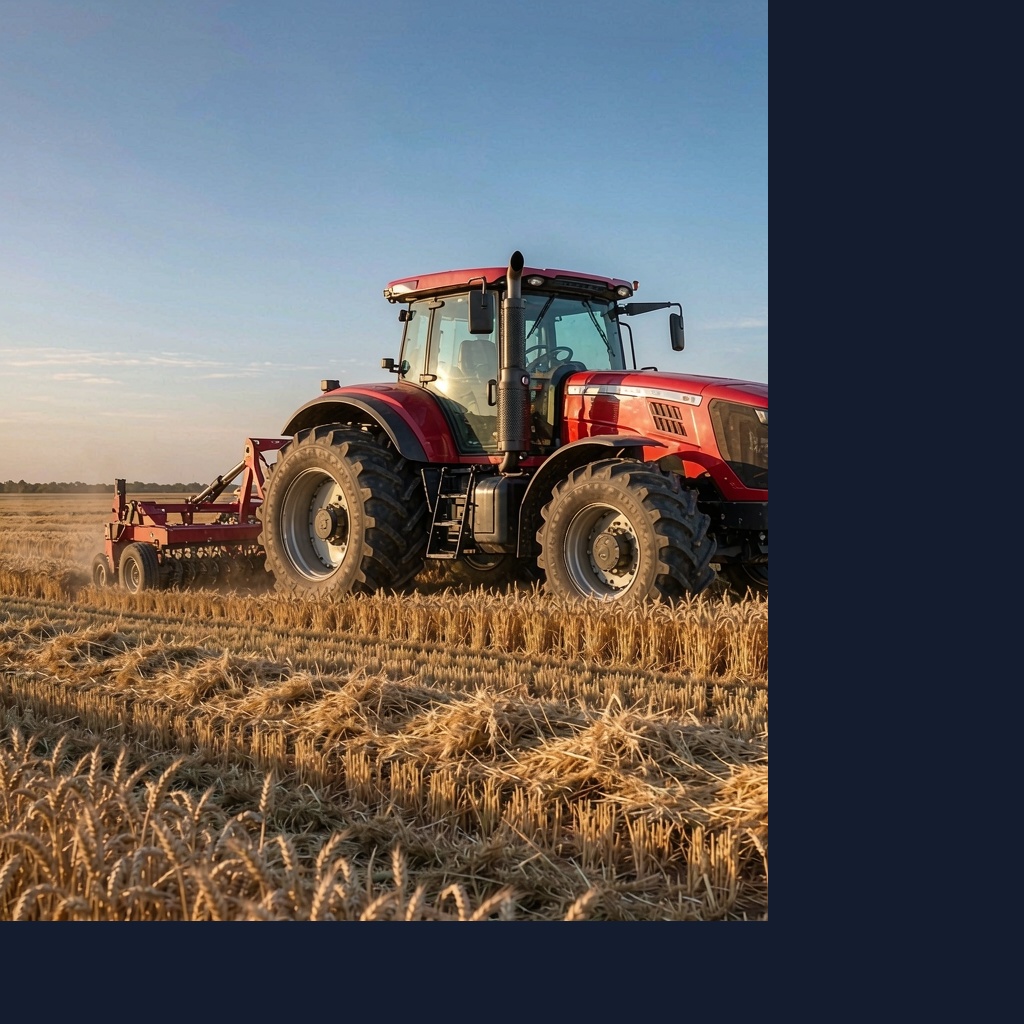
Why 200HP 4WD Tractors Are the Fastest-Growth Segment in 2026
Farm consolidation and broad-acre row-crop operations are pushing procurement teams toward high-horsepower 4WD tractors. According to 2026 market data, the 4-wheel-drive tractor segment is projected to grow at a 7.6% CAGR through 2031, while the >200 HP class is forecast to expand at 7.5% CAGR—the fastest rate across all power bands. In China, large-tractor production surged 58.6% year-on-year in June 2026, reflecting global demand for machines that can cover more hectares per hour, pull heavier implements, and reduce seasonal labor pressure.
For buyers importing equipment for large-scale grain, corn, or soybean operations, the decision is no longer just “how much horsepower?” It is about matching engine rating to implement load, verifying emissions compliance for the destination market, and calculating true 5-year total cost of ownership (TCO). This guide focuses on the 160–200HP 4WD farm tractor class and anchors every specification to the LUYRN tractor lineup currently available for B2B export.
Matching Horsepower to Field Operation
A 200HP tractor is not simply a bigger version of a 90HP unit. The jump from 120HP to 200HP changes the implement class, fuel system, cooling capacity, and chassis load. Use this rule of thumb when sizing a 4WD tractor for broad-acre work:
- 70–90HP: Mowing, light tillage, small loader work, orchard and vineyard tasks. LUYRN 704 70HP and LX904 90HP fit this band.
- 100–120HP: Mid-duty tillage, seeding, haymaking, and dairy/livestock support. Consider the 1204 120HP orchard tractor or LY1204 120HP.
- 160–200HP: Heavy primary tillage, deep ripping, large planters, heavy balers, and grain cart hauling on flat to rolling terrain. This is where the LUYRN LX1604 160HP Stage V, LX2004-M 200HP, and LMA2004 200HP operate.
Buyers often oversize by 10–15% to account for altitude derating, PTO-driven implements that load the engine independently of travel speed, and future implement upgrades. If your current 140HP tractor is at 85% engine load during spring tillage, a 160HP or 200HP unit provides the reserve capacity that protects engine life and improves daily productivity.
LUYRN 160–200HP 4WD Tractor Model Comparison
LUYRN currently stocks three high-horsepower 4WD tractors for B2B buyers. The following table compares the key procurement specs a fleet manager needs before issuing a purchase order.
| Model | Engine Power | Emissions | Drive | Best Application | Product Page |
|---|---|---|---|---|---|
| LX1604 | 160HP | Stage V | 4WD | Heavy tillage, large planters, grain operations | View LX1604 |
| LX2004-M | 200HP | CE/OEM | 4WD | Broad-acre row-crop, deep ripping, heavy transport | View LX2004-M |
| LMA2004 | 200HP | CE/ISO/OEM | 4WD | Large farm contractor work, heavy-duty field tasks | View LMA2004 |
Both 200HP models share the same nominal power rating, but frame geometry, hydraulic pump capacity, rear hitch category, and fuel tank size can differ. Request the detailed spec sheet for each unit and confirm that the rear three-point hitch is Category II or III, depending on whether you plan to run 4-meter tillage tools or 6-meter planters.
Stage V, Fuel Economy, and 2026 Emissions Compliance
Emissions compliance is now a procurement gate, not an afterthought. The LUYRN LX1604 160HP tractor is explicitly listed as Stage V, making it suitable for European markets and any region that enforces EU-equivalent nonroad emission limits. For buyers targeting markets without Stage V mandates, the LX2004-M and LMA2004 provide CE/OEM configurations that balance purchase price with export documentation.
Industry benchmarks for 2026 show that emissions-compliant diesel powertrains add cost, but they also deliver measurable fuel savings. Modern common-rail engines with DOC/DPF/SCR after-treatment typically achieve:
- 10–15% lower fuel consumption versus pre-Stage-V engines at equivalent load.
- Extended service intervals when paired with high-quality DEF/AdBlue and low-ash engine oil.
- Higher resale value in markets where Stage V/Tier 4 Final certification is mandatory.
For context, hybrid tractors are gaining share in the 100–200HP band and can cut fuel use by up to 30%, but they carry a 20–25% purchase premium and require charging or generator infrastructure. For most broad-acre operations in 2026, a clean-diesel Stage V 4WD tractor remains the pragmatic choice for high annual hour use.
Hydraulics, PTO, and Hitch: The Implement Compatibility Checklist
A 200HP tractor is only as productive as the implements it can operate. When evaluating the LX1604, LX2004-M, or LMA2004, request these values in writing:
| Spec | Why It Matters | Checklist Item |
|---|---|---|
| Hydraulic pump flow | Higher flow (L/min) lets you lift heavier implements faster and run large seeders or loaders | Confirm main pump L/min at rated engine speed |
| Remote valves | Planters, trailers, and folding implements need multiple double-acting spools | Request number of rear remotes and load-sensing option |
| PTO speed | 540/540E/1000 RPM compatibility determines which PTO implements can run | Confirm 540E economy and 1000 RPM availability |
| Three-point hitch | Category II/III lift capacity sets the upper implement weight limit | Verify lift capacity at lower link ends (kg) |
| Drawbar pull | Direct measure of how much the tractor can pull through soil | Ask for certified drawbar test data |
For 160–200HP tractors, expect a rear lift capacity of at least 4,500–6,500 kg and a PTO that supports both 540 and 1,000 RPM. If your operation runs heavy rotary cutters or forage harvesters, prioritize models with an independent PTO and wet clutch for durability.
5-Year TCO Framework for High-Horsepower Tractors
Purchase price is only the first line item. A 200HP tractor working 800–1,200 hours per year accumulates fuel, maintenance, and downtime costs that can exceed the original invoice. Use the framework below to compare the LX1604, LX2004-M, and LMA2004 against any incumbent fleet unit.
| Cost Driver | Typical 5-Year Range | Procurement Action |
|---|---|---|
| Fuel | 35–45% of total operating cost | Lock in engine fuel maps and request field consumption (L/ha) |
| Scheduled maintenance | 8–12% of operating cost | Confirm oil/filter intervals and parts lead time |
| Tires/tracks | 10–15% for 4WD row-crop treads | Specify radial vs. bias ply and load rating |
| DEF/AdBlue | 2–4% for Stage V models | Estimate annual DEF volume with supplier |
| Resale/depreciation | 40–55% retained value after 5–7 years | Demand CE/ISO documentation to protect export resale |
A 200HP Stage V tractor used 1,000 hours per year typically consumes 12–18 L/h of diesel depending on load and field conditions. At 2026 diesel prices, fuel alone can represent $25,000–$40,000 over five years, so a 10% fuel-efficiency improvement from a common-rail Stage V engine pays back a meaningful portion of the emissions premium.
Supplier Evaluation Checklist for 160–200HP Tractor Imports
High-horsepower tractors are capital assets, not consumables. Before placing an order, verify the supplier can support the machine across its full lifecycle:
- Certification pack: CE, ISO, and Stage V (where applicable) certificates plus engine emission test reports.
- Engine and drivetrain origin: Confirm engine brand, transmission type, and axle manufacturer; these determine parts availability.
- Spare parts stocking: Ask for common-wear parts list, MOQ, and air-freight lead time for critical components.
- Technical documentation: Operator manual, wiring diagram, hydraulic schematic, and parts book in buyer’s language.
- Warranty terms: Engine, drivetrain, and hydraulic system coverage, including hour limits and geographic scope.
- Pre-shipment inspection: PDI checklist, load test, and photo/video evidence before container sealing.
- Logistics support: HS code classification, packaging for RORO or container, and destination-port customs coordination.
LUYRN provides OEM/ODM documentation, CE/ISO certification support, and pre-shipment inspection records for all 4WD tractors including the LX1604, LX2004-M, and LMA2004.
Frequently Asked Questions
What is the difference between the LX2004-M and LMA2004?
Both are 200HP 4WD tractors, but they are distinct model lines with different frame dimensions, hydraulic configurations, and hitch details. Request side-by-side spec sheets to compare lift capacity, fuel tank size, PTO options, and cab layout before selecting the better fit for your implements.
Is the LX1604 Stage V certified for Europe?
Yes, the LUYRN LX1604 160HP 4WD tractor is listed as Stage V. Confirm the destination country’s homologation requirements and request the emission test report and exhaust after-treatment documentation as part of the procurement pack.
How many annual hours justify a 200HP tractor over a 120HP model?
If the machine will run more than 600 engine hours per year on implements that load the tractor above 75% of rated power, the productivity gain from a 160–200HP unit usually justifies the higher purchase price within two to three seasons.
Should I choose Stage V or a lower emission tier for export?
Choose Stage V if the destination market enforces EU-equivalent nonroad limits. For markets without Stage V mandates, a CE/OEM configuration may reduce upfront cost. Always verify local import regulations before ordering, because retrofitting after-treatment after arrival can cost 8–15% of the tractor price.
What implements pair best with a 200HP 4WD tractor?
Primary tillage tools (subsoilers, moldboard plows, disc harrows), 4–6 meter seeders, large rotary cutters, forage harvesters, and heavy grain carts. Match implement draft load to the tractor’s drawbar pull and three-point-hitch lift capacity.
Request a Quote for LUYRN 160–200HP 4WD Tractors
LUYRN supplies B2B buyers with high-horsepower 4WD tractors designed for broad-acre and row-crop operations. Whether you need a Stage V 160HP LX1604, a 200HP LX2004-M, or a 200HP LMA2004, our team can provide spec sheets, certification documentation, and container shipping quotes.
For a 24-hour quotation, email info@luyrn.com with your target horsepower, destination market, and primary implements. You can also review our general Farm Tractor Procurement Guide for the full 70–200HP range.