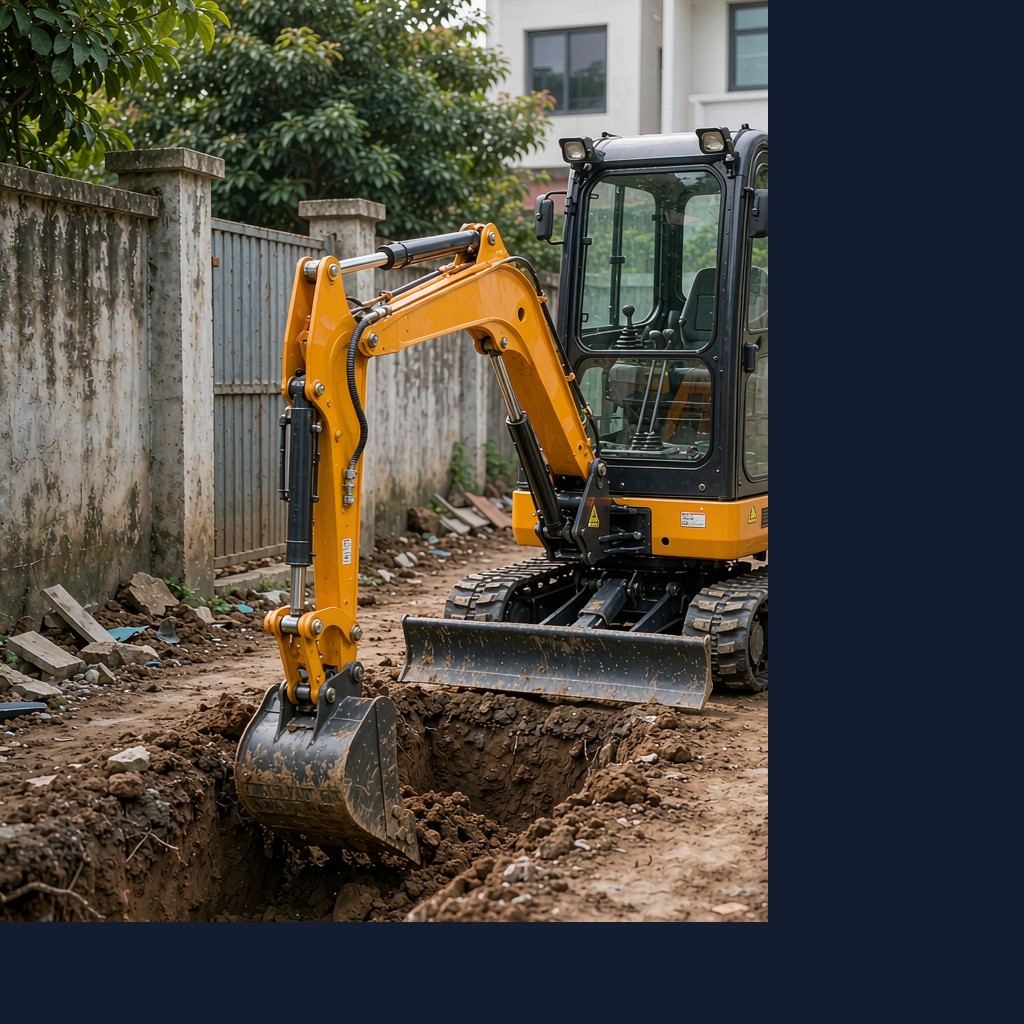
Why the 1–2.5 Ton Class Is the Fastest-Growing Segment in 2026
If you run a landscaping crew, a utility contractor business, a rental fleet, or a general construction company that keeps hitting backyard-access problems, the machine you are probably shopping for is a 1 to 2.5 ton mini excavator. This micro class has become the fastest-moving segment of the compact equipment market: global rental penetration for compact equipment now sits around 45%, and in the US roughly 62% of contractors rent at least part of their fleet each year — which means dealers and fleet owners are replenishing micro machines constantly, and end users are comparing buy-vs-rent math more carefully than ever.
The appeal is simple. A machine under 2.5 tons fits through a standard fence gate, rides on a light trailer towed by a pickup, digs utility trenches and footings all day on a few liters of diesel, and costs a fraction of a 6-ton class excavator to buy, fuel, and maintain. The risk is equally simple: buy too small and the machine cannot do the work; buy too big and it cannot reach the backyard in the first place.
This guide walks through the entire 1–2.5 ton buying decision for 2026 — matching machine class to real jobs, comparing LUYRN’s five in-stock models (HL10, HL18, HL20, HL22, HL26U), understanding zero-tail vs conventional layouts, computing ownership economics, and the compliance checklist every B2B buyer should run before wiring a deposit.
Match the Machine to the Job: What Each Weight Class Actually Does
Before comparing spec sheets, anchor the purchase in the work. In the micro class, a few hundred kilograms changes what the machine can do dramatically.
| Class | Operating Weight | Typical Jobs | Access | Transport |
|---|---|---|---|---|
| Micro / sub-1t | 0.8–1.0 t | Garden trenches, post holes, small footings, indoor demolition | Standard 36–40 in gates, elevators in some cases | Small trailer, light pickup |
| Compact 1–1.5 t | 1.0–1.5 t | Irrigation lines, drainage, stump removal, landscaping | Wide gates, side yards | Single-axle trailer |
| Mid-micro 2–2.2 t | 2.0–2.2 t | Utility service lines, septic laterals, small foundations | Backyard via 1.2 m+ opening | Tandem trailer |
| Upper-micro 2.5 t | 2.4–2.6 t | Deeper utility work, pool preps, light demolition, daily rental workhorse | Needs ~1.3–1.5 m opening | Tandem trailer, brake axles |
Rental benchmarks make the economics clear. A 1–2 ton machine rents for roughly $150–$250 per day, $600–$900 per week, or $2,000–$2,500 per month in most markets, and a 2.5–3 ton unit runs $250–$400 daily. Across the industry, the breakeven rule of thumb is: under 80–100 hours per year, renting wins; above 150 hours per year, owning wins decisively — a purchased micro running 600 hours a year delivers an effective hourly cost of $35–$45 all-in, versus $45,000–$55,000 spent renting the same utilization over five years.
LUYRN’s 1–2.5 Ton Lineup: Five Models Compared
LUYRN stocks five crawler mini excavators spanning this class, all CE-marked and export-ready. Here is how they stack up:
| Model | Operating Weight | Bucket Capacity | Bucket Width | Fuel Tank | Overall Width | Best Fit |
|---|---|---|---|---|---|---|
| HL10 (1 ton) | 0.85 t | 0.018 m³ | 400 mm | 6.6 L | 935 mm | Gate-access backyard work, indoor demo |
| HL18 (1.4 t) | 1.4 t | 0.04 m³ | 420 mm | 13.5 L | 1,100 mm (body 945 mm) | Landscaping, irrigation, nurseries |
| HL20 (2 t) | 2.1 t | 0.07 m³ | 430 mm | 16 L | 1,060 mm | Narrow-access utility trenching |
| HL22 (2.2 t) | 2.1 t | 0.07 m³ | 430 mm | 16 L | 1,350 mm (body 1,060 mm) | Balanced utility + landscaping daily driver |
| HL26U (2.6 t) | 2.5 t | 0.075 m³ | 500 mm | 16 L | 1,500 mm (body 1,260 mm) | Heaviest digging duty in the micro class |
Three selection patterns emerge from this table:
- The 935 mm HL10 is the only machine here that threads a standard residential gate without removing fence panels. Rental fleets love it because a single operator can trailer it solo, and its 6.6 L tank plus sub-1.5 L/h fuel burn keeps daily running costs near zero.
- The HL18 occupies the sweet spot for landscapers — at 1.4 t it still fits through most side-yard openings, but its 0.04 m³ bucket moves four times the material of the HL10 per cycle.
- HL20 vs HL22 is a narrow-body decision: both carry the same 2.1 t weight class and 0.07 m³ bucket, but the HL20’s 1,060 mm overall width fits tighter sites, while the HL22’s wider stance gives more stability for lifting and deeper trench work.
- The HL26U is the step-up machine: same physical footprint class as a 3-ton excavator’s digging capability, but positioned at 2.5 t operating weight where many markets’ license and trailer rules stay simpler.
When your jobs regularly exceed 2.5 tons of demand, the natural next step is the HL35U 3.5-ton zero-tail excavator or the HL30 3-ton small excavator — both covered in detail in our 3-ton mini excavator buying guide.
Zero-Tail vs Conventional Tail Swing in the Micro Class
Tail swing is the spec buyers most often underweight. A conventional-tail machine (like the HL20/HL22) has a lower purchase price and better dig geometry, but the counterweight overhangs the tracks — typically by 600–800 mm in this class. Rotate the cab next to a fence, wall, or flowerbed and you either stop work or leave a trail of damage claims.
Zero-tail (or minimal-tail) designs keep the counterweight inside the track width, allowing full 360° rotation against a wall with a safe margin. For urban utility crews and residential landscapers, this is often worth the premium alone: working within 300 mm of a vertical obstruction is routine in trench-adjacent and foundation-adjacent work. For open rural sites, farm drainage, and greenfield landscaping, conventional tail is the rational budget choice.
Also verify retractable undercarriage if tight access is your core use case. Machines in this class with adjustable tracks can narrow to pass a 1-meter opening, then extend for digging stability — a capability that meaningfully widens the jobs a single machine can accept.
Specs That Matter More Than Horsepower in 2026
Marketing sheets lead with horsepower. Procurement teams should verify these instead:
| Spec | Why It Matters | What to Verify |
|---|---|---|
| Dig depth at max reach | Determines whether utility mains and footings are reachable | Ask for depth at ground level AND at full reach (can be 20–30% less) |
| Hydraulic flow to aux line | Breakers, augers, thumbs all draw from aux hydraulics | Get GPM/L/min + pressure rating; compare to attachment requirements |
| Dozer blade | Backfilling and grading; also adds stability when digging | Standard vs optional; width vs track width |
| Track type and width | Rubber tracks protect lawns and paving; width drives ground pressure | Rubber standard on all LUYRN micro models; check ground pressure spec |
| Service intervals | Micro machines used for short jobs accumulate idle hours | Engine oil / hydraulic filter intervals in writing |
| ROPS/canopy | Jobsite and rental-fleet insurance requirements | HL26U offers 2,280/2,450 mm height variants — confirm canopy spec |
Fuel economy in this class is a rounding error compared to larger machines — expect roughly 1–2 L/h under normal load — so running costs are dominated by maintenance, transport, and operator time, not diesel. That is precisely why transport logistics and fit-through-access matter more per dollar in the micro class than in any other excavator category.
Attachments: Buying One Machine Instead of Five
The micro class earns its keep through attachments. Buckets in 300–600 mm widths handle trench-to-grading work; hydraulic breakers extend into light demolition; augers turn the machine into a fence-post and tree-planting system; thumbs and grapples handle brush and debris. A typical $40–$150/day attachment rental cost means a landscaper renting an auger every two weeks buys the attachment outright in a single season.
Two compatibility items must be confirmed in writing before ordering:
- Pin dimensions of the quick hitch / coupler (width, diameter, spacing) so future attachments from any supplier fit;
- Auxiliary hydraulic flow and pressure, matched with 5–10% headroom to the attachments you plan to run.
For a deeper treatment, see our guides on mini excavator attachment compatibility and quick-hitch standards and excavator attachments.
Ownership Economics: The 2026 TCO Snapshot
A realistic five-year ownership model for a 1–2.5 ton machine running 300–600 hours a year:
| Cost Item | Micro Class (1–2 t) | Upper-Micro (2.5 t) |
|---|---|---|
| Purchase (ex-works, China-built, CE) | $5,000–$12,000 | $9,000–$16,000 |
| Fuel (1–2 L/h, 500 h/yr) | $1,200–$2,500 / 5 yrs | $1,500–$3,000 / 5 yrs |
| Maintenance & wear parts | $400–$900 / yr | $600–$1,200 / yr |
| Rubber tracks (replace ~1,500–2,500 h) | $600–$1,200 / set | $800–$1,500 / set |
| 5-yr residual value | 40–55% of purchase | 40–55% of purchase |
Compare that to renting: a micro at $2,000–$2,500/month runs $10,000–$12,500 for a five-month season alone, every year, with zero equity at the end. For a business using the machine 100+ hours annually, purchase typically pays back inside 12–24 months. For rental-fleet operators, the micro class is attractive precisely because daily rates of $200–$250 against a $6,000–$10,000 asset produce a sub-18-month payback at even 40% utilization.
Supplier & Compliance Checklist Before You Wire the Deposit
- CE marking documentation — declaration of conformity, not just a sticker. All LUYRN micro models are CE-certified; ask for the certificate copy per serial number.
- Engine and pump brand disclosure — confirm engine manufacturer and emissions stage (Tier 3/Stage V as applicable to your market) in the contract, not the listing.
- Spare parts availability — filters, buckets, pins, and track parts with stated lead times; a micro excavator down for six weeks erases a season’s margin.
- Factory audit or video inspection — ISO 9001 certification and a video walkaround of your actual serial-numbered unit before shipment.
- Shipping and customs — confirm crate dimensions/weight for your trailer and port; micro machines typically ship 3–4 per 20 ft container.
- Post-delivery support — remote troubleshooting and parts courier terms in writing.
Frequently Asked Questions
Can a 1-ton mini excavator really fit through a backyard gate?
Yes. The LUYRN HL10 is 935 mm (36.8 in) wide, which passes standard 36–40 in residential gates without removing fence panels. Its 0.85 t operating weight also keeps it on small single-axle trailers that a light pickup can tow legally.
What is the realistic dig depth of a 2-ton mini excavator?
Micro-class machines in the 2–2.5 ton range typically dig 2.2–2.8 m at ground level, with somewhat less at maximum reach. Verify both figures with the supplier, and remember soft or rocky soil may require stepping up one class.
Mini excavator: rent or buy in 2026?
Use annual hours: under 80–100 hours, rent; above 150 hours, buy. At 500 hours a year, owning a micro costs roughly $35–$45 per hour all-in versus $45,000–$55,000 over five years for equivalent rental spend.
Which LUYRN model for utility trenching in tight residential lots?
The HL20 — its 1,060 mm width and 0.07 m³ bucket combine narrow-access capability with real trenching productivity. For sites that allow 1.35 m width, the HL22 offers a more stable stance at the same weight class.
Do these machines come with CE certification for export?
All LUYRN mini excavators ship CE-marked with export documentation, and the HL22 additionally carries ISO certification. Request the declaration of conformity per unit as part of your purchase contract.
Get a Same-Week Quote from LUYRN
Whether you are equipping a landscaping crew, building a rental fleet, or adding a backyard-access machine to a construction lineup, LUYRN’s 1–2.5 ton crawler excavators are in stock, CE-ready, and export-packed. Email info@luyrn.com with your target jobs, annual hours, and destination port, and our team will recommend the right model and configuration with a formal quotation — typically within 24 hours.