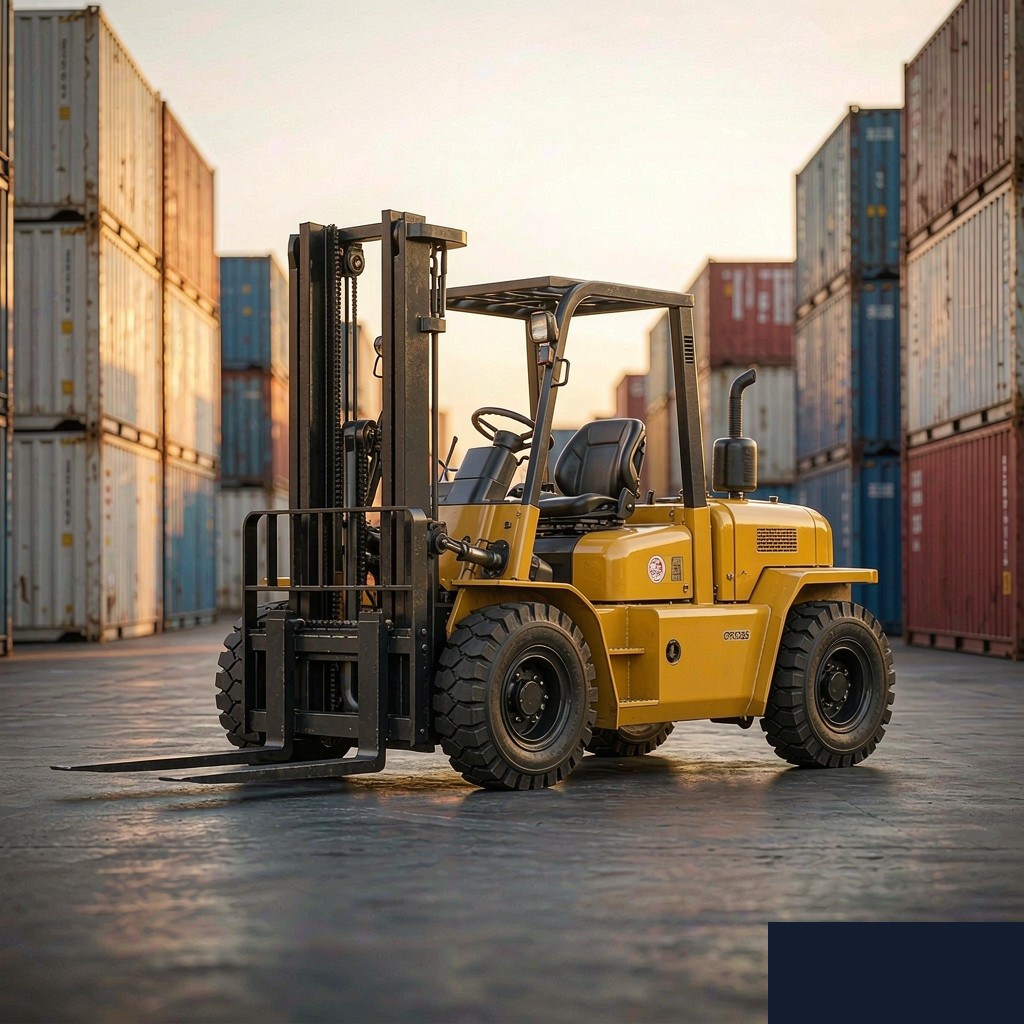
Quick Answer: When Does a Diesel Forklift Still Make Sense in 2026?
Despite the rapid rise of lithium-ion warehouses, the diesel forklift remains the default choice for outdoor yards, building-material depots, ports, lumber yards and any site where electricity is unreliable or absent. The logic in 2026 is simple: diesel refuels in minutes rather than hours, holds its rated capacity through multi-shift duty, and handles gravel, ramps and uneven ground that would wreck a cushion-tyre electric truck. Fleet studies consistently show that over a 10-year life cycle, diesel wins on energy cost in two-shift outdoor fleets, while electric only pays back in single-shift indoor operations.
So the decision rule is: if your loads live outdoors and your shifts are long, buy diesel; if your work is indoor and single-shift, buy electric. If you are still weighing the two, our diesel-vs-electric TCO comparison and electric forklift buying guide cover the crossover points in detail. The rest of this guide assumes diesel is the right call and answers the harder question: which diesel forklift, configured how, and at what running cost?
Step 1: Match the Capacity Class to Your Load and Site
Capacity ratings are set at a specific load centre — 500 mm on the 2–5 tonne classes, 600 mm from 6 tonnes up — which represents a balanced, cube-shaped load. A drum, a long steel beam or an attachment that pushes the load centre outward will derate the truck well below its nameplate number. Before comparing models, weigh your heaviest routine pallet (not your average one), note its load centre, and add margin for ramps and uneven ground, which can add 30–50% to fuel burn and meaningfully reduce effective capacity.
LUYRN’s in-stock HLCPC diesel line spans ten models from 2 to 10 tonnes. All ship with a 3,000 mm two-stage mast as standard; free lift (how far the forks rise before the mast extends) scales from 60 mm on the light classes to 220 mm on the 10-tonner, which matters for container and low-doorway work.
| Model | Rated capacity | Load centre | Free lift | Best fit |
|---|---|---|---|---|
| HLCPC20 | 2,000 kg | 500 mm | 60 mm | Light outdoor docks, workshops, farms |
| HLCPC25 | 2,500 kg | 500 mm | 60 mm | General pallet handling, small yards |
| HLCPC30 | 3,000 kg | 500 mm | 80 mm | The volume class — building supply, logistics |
| HLCPC35 | 3,500 kg | 500 mm | 80 mm | Denser palletised goods, brick packs |
| HLCPC40 | 4,000 kg | 500 mm | 80 mm | Heavier mixed loads, construction depots |
| HLCPC50 | 5,000 kg | 500 mm | 150 mm | Lumber, steel offcuts, heavy pallets |
| HLCPC60 | 6,000 kg | 600 mm | 150 mm | Block packs, machinery handling |
| HLCPC70 | 7,000 kg | 600 mm | 150 mm | Steel service centres, timber yards |
| HLCPC80 | 8,000 kg | 600 mm | 150 mm | Port sidings, heavy fabrication |
| HLCPC100 | 10,000 kg | 600 mm | 220 mm | Container handling, stone and concrete |
A practical sizing tip from fleet procurement: buy the class above your heaviest routine load, not at it. A 3-tonne truck spending its life at 2,800 kg will burn 20–40% more fuel working near rated capacity, and its drivetrain and mast chains will age visibly faster than a 3.5-tonne unit doing the same job.
Step 2: Emissions Compliance — Tier 4 Final, Stage V, and What to Verify in Writing
Emissions hardware is the single biggest hidden price driver on a 2026 diesel forklift. Engines sold into the EU must meet Stage V (Regulation 2016/1628) and into the US EPA Tier 4 Final — the two frameworks demand the same family of aftertreatment: a diesel oxidation catalyst (DOC), a diesel particulate filter (DPF) and, on most 19–75 kW engines, selective catalytic reduction (SCR) with AdBlue dosing. This compliance package typically lifts the new purchase price by 8–18% versus an older Tier 3 unit of the same capacity.
The running-cost implications deserve their own line in your budget, not a footnote:
- DPF regeneration every 200–400 operating hours; short-cycle duty may require scheduled forced regeneration to prevent clogging.
- AdBlue and filter servicing add roughly US$1,500–3,500 per year versus a Tier 3 machine; Stage V filter kits cost about 1.6–2.0× their Tier 3 equivalents.
- Tier 4 Final engines recover part of that premium — modern common-rail injection improves fuel economy by 10–20% under comparable loads versus older mechanical injection.
For import buyers there is one trap to close explicitly: some domestic-market units ship configured to China-IV non-road limits only. If your project sits in a regulated zone, retrofitting DPF + SCR + AdBlue typically costs 8–15% of the truck price — more than ordering the correct configuration upfront. Confirm the engine brand and emission tier in writing in the purchase contract, and ask for the certification document, not a brochure claim. Our HLCPC20 is offered in a Tier 4 configuration for exactly this reason, and we supply emission documentation with every export order. For the wider certification picture, see our comparison of CE and ISO standards for industrial machinery.
Step 3: Fuel Consumption and the Real Running Budget
Fuel is the largest single running cost on a diesel forklift, and it scales with tonnage and duty severity. Published consumption bands give a realistic planning basis:
| Capacity class | Typical consumption | Notes |
|---|---|---|
| 2.0–3.5 t (HLCPC20–35) | 2.0–3.5 L/h | Docks, light yard duty, partial loads |
| 4.0–5.0 t (HLCPC40–50) | 3.5–6.0 L/h | Mixed yard work, heavier pallets |
| 6.0–8.0 t (HLCPC60–80) | 5.0–8.0 L/h | Steel, timber, block handling |
| 10 t (HLCPC100) | 8–12 L/h | Container and stone duty, near-capacity cycles |
Worked example for the most common purchase, a 3-tonne class truck: at a realistic 3.0 L/h over 2,000 operating hours per year, you burn about 6,000 litres annually — roughly US$6,000–7,000 at typical international industrial diesel prices. Add scheduled maintenance of US$3,000–5,000 per year (diesel forklifts service every 250–500 hours: engine oil, hydraulic, fuel and air filters) and tyres, and fuel plus maintenance will dwarf the purchase price within three to four years.
Two levers cut that bill without touching the spec sheet. First, idle time: fleets routinely log 30–40% of engine hours at idle, each still burning 0.5–1.0 L/h doing nothing. Second, operator behaviour: telematics monitoring and basic driver training reliably pull fleet consumption down 10–20% from baseline. On a 3-tonne truck, that is US$600–1,400 a year back.
Step 4: Mast, Free Lift, Tyres — Specs That Change the Quote
Three specification choices that buyers under-weight, each of which changes both price and daily usability:
- Mast stages and free lift. The standard two-stage mast with 3,000 mm lift and modest free lift suits open yards. If the truck must enter containers or pass low doorways with the load, specify a three-stage mast with high free lift — the HLCPC100’s 220 mm free lift exists precisely for container entry. Lifting above the standard height derates capacity; ask for the derated capacity chart at your working height before ordering, not after.
- Tyre type. Pneumatic tyres are correct for gravel yards and uneven ground; solid (resilient) tyres suit scrap, glass and demolition yards where punctures are routine; cushion tyres are for smooth indoor concrete only — pairing them with outdoor diesel duty destroys both tyres and driveline.
- Attachments. Side-shifters, fork positioners, rotators and bale clamps all draw hydraulic flow and add weight that eats into rated capacity. Confirm the attachment’s hydraulic demand and the truck’s derated capacity with the attachment fitted — this is a written spec item, same as the emission tier.
Step 5: Supplier Checklist for Import Buyers
Before wiring any deposit on an imported diesel forklift, lock these seven items:
- Engine brand, model and emission tier stated in the purchase contract, with certification documents.
- CE declaration and ISO 9001 manufacturing certification copies supplied with the quotation.
- Load test certificate — a rated-capacity test at 110% documented before shipment.
- Parts manual and a 12-month consumables kit (filters, fuel-water separator elements, mast chains) quoted alongside the truck.
- Incoterms stated explicitly — FOB vs CIF changes who owns risk at sea, and marine freight for a 4–10 t truck is not a rounding error.
- Pre-shipment inspection with timestamped photos and video of the engine running, mast cycling and data plate.
- Spare parts supply commitment in writing — response time for critical parts, not just “support available”.
Frequently Asked Questions
How long does a diesel forklift last?
A well-maintained diesel counterbalance truck commonly reaches 10,000–15,000 operating hours before major overhaul — 5–7 years at 2,000 hours a year. Keep service records from day one: they are also what preserves 45–55% resale value in the 5–8 year window.
Can I use a diesel forklift indoors?
Not in occupied spaces. Diesel exhaust produces carbon monoxide, NOx and particulates that standard warehouse ventilation does not dilute safely. For indoor aisles, use an electric truck — that is precisely the use case our LiFePO4 electric range is built for.
What is the difference between Tier 4 Final and Stage V?
They are the US EPA and EU frameworks respectively, demanding equivalent aftertreatment technology from the same engine families. A truck certified to one is typically exportable to the other with documentation updates — confirm with the supplier per engine model.
What does a 3-ton diesel forklift cost in 2026?
A new Chinese-built 3-tonne unit typically lands between US$15,000–25,000 ex-works depending on mast and options; Western-brand 4–5 t Stage V trucks run US$30,000–80,000; used 2.5-tonne machines trade at US$12,000–28,000. Spec, not brand, moves the final number most.
Get a Diesel Forklift Matched to Your Site
Every model in the HLCPC 2–10 tonne diesel range is in stock and configurable — mast, tyres, attachments and emission tier — before it ships. Send us your heaviest load, its load centre, and a sentence about your yard surface, and we will return a matched configuration with an itemised quote. Email info@luyrn.com or read the general forklift procurement guide before you shortlist.