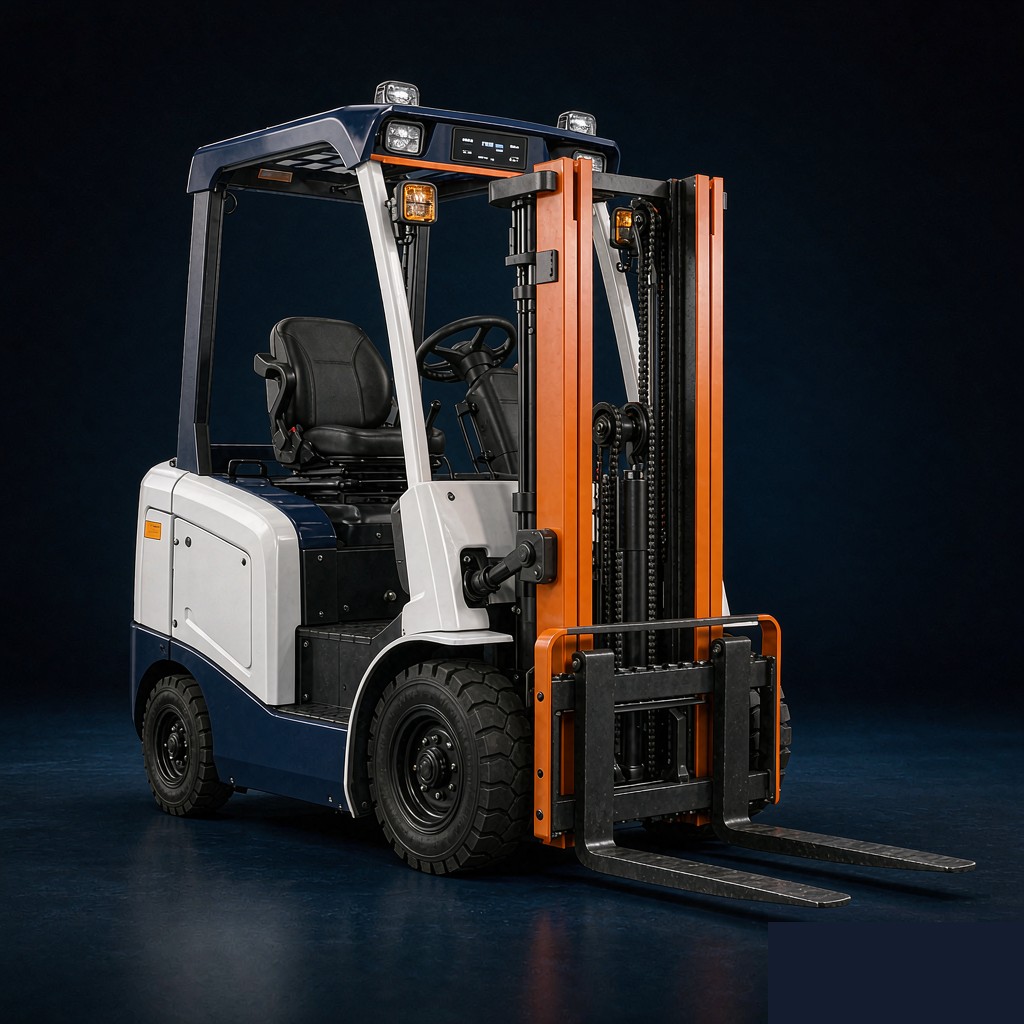
Quick Answer: When Does an Electric Forklift Make Sense in 2026?
Buy an electric forklift in 2026 if your trucks run indoors, your fleet works more than roughly 1,500 hours per year, and your operation can charge during breaks. Electric counterbalance forklifts now account for the majority of global units sold by volume, and lithium iron phosphate (LiFePO4) is projected to overtake lead-acid inside the electric segment this year — driven almost entirely by total cost of ownership (TCO), not sticker price. The three decisions that separate a productive asset from an expensive regret are capacity class, battery chemistry, and supplier qualification. This guide walks through each one with the numbers import buyers actually need, using LUYRN’s CE-certified HLC series (1–5 ton electric, 2–10 ton diesel) as the reference lineup.
Step 1: Match the Capacity Class to Your Real Load
Nameplate capacity is rated at a 500 mm load center on a standard pallet. Real-world capacity drops fast once you lift higher, use long or non-standard loads, or add attachments — a safe procurement rule is to size the truck at roughly 80% of nameplate for your heaviest routine pallet. Before comparing quotes, weigh (don’t estimate) your heaviest pallet, measure the load center, and confirm maximum lift height, because mast height affects residual capacity on every model.
| Typical Application | Capacity Class | LUYRN HLC Model | Best Fit |
|---|---|---|---|
| Light e-commerce, mezzanine, narrow aisles | 1.0–1.5 t | HLC10 1-Ton Electric Forklift (LiFePO4), HLC15 1.5-Ton | Standard 1 t pallets, tight indoor spaces |
| General warehousing, distribution centers | 2.0–2.5 t | HLC20 2-Ton Warehouse, HLC25 2.5-Ton | The volume class for most 3PL and retail DCs |
| Manufacturing, building materials, heavy pallets | 3.0–3.5 t | HLC30 3-Ton, HLC35 3.5-Ton | Global workhorse class; best electric value per ton |
| Ports, steel, masonry, outdoor yards | 4.0–5.0 t | HLC40 4-Ton, HLC50 5-Ton | Heavy pallets where emissions rules block diesel |
One caution for outdoor buyers: sealed industrial buildings are the natural habitat of any 3-ton electric forklift. If your duty cycle is mostly unpaved yards, rain exposure, or long outdoor travel distances, a diesel counterbalance such as the HLCPC30 3-Ton Diesel (Tier 4 options available across the HLCPC range) will usually deliver a lower lifetime cost. For a side-by-side energy-cost comparison, see our diesel vs. electric forklift TCO analysis.
Step 2: LiFePO4 vs. Lead-Acid — the Decision That Sets Your TCO
Battery chemistry is the single largest line item after the chassis itself, and in 2026 the gap has widened beyond what most 2019-era comparisons show. Industry benchmarks now put LiFePO4 cycle life at 2,000–5,000 cycles versus 1,000–1,500 for flooded lead-acid, with round-trip charging efficiency of roughly 95% against 70–80%. In practice that means one lithium pack often outlives the truck, while a lead-acid fleet budget should assume one or two replacement batteries per truck within a decade.
| Factor | Flooded Lead-Acid | LiFePO4 Lithium |
|---|---|---|
| Cycle life | 1,000–1,500 cycles (3–5 years) | 2,000–5,000 cycles (7–10+ years) |
| Charging efficiency | 70–80% | ~95% |
| Full charge time | 8 hours + 8 hours cool-down | 1–2 hours, no cool-down |
| Opportunity charging | Not recommended (sulfation risk) | Fully supported, no degradation penalty |
| Routine maintenance | Weekly watering, equalization, terminal cleaning | None |
| Dedicated battery room | Required (ventilation, acid-proof flooring) | Not required; charges in-machine |
| Spare batteries per truck (multi-shift) | 1–2 additional sets | None |
The LUYRN HLC10 1-Ton ships with LiFePO4 as standard, and the larger HLC models can be specified with lithium packs for buyers running multi-shift operations. If your fleet is single-shift with low annual hours, a quality lead-acid configuration still pencils out — run the duty-cycle math below before paying the lithium premium.
Step 3: Run the Duty-Cycle Math Before You Sign Anything
Chemistry only pays for itself when utilization is high enough. Work through these four numbers per truck:
- Working hours per day. One shift of 6–8 hours with overnight charging is the classic lead-acid use case. Two or more shifts, or continuous flow with micro-breaks, is where lithium wins decisively.
- Energy per shift. A 3-ton electric forklift typically draws 8–12 kWh per shift hour. At 95% vs. 75% charging efficiency, the difference compounds on every truck, every night.
- Break structure. LiFePO4 accepts 15–30 minute opportunity charges that add 15–40% state of charge with no cycle-life penalty — many lithium fleets eliminate battery swaps entirely and keep trucks on the floor.
- Payback window. 2025–2026 industry analyses put lithium payback at 18–30 months for three-shift operations, 24–36 months for two-shift warehouses, and 36–48+ months for single-shift, low-utilization fleets. Five-year TCO reductions of 30–50% are typical for high-utilization fleets, with documented savings of $20,000–$30,000+ per truck in multi-shift settings.
Worked example: a 10-truck, two-shift warehouse running lead-acid needs roughly two battery sets per truck, a changing station, watering labor, and one mid-life battery replacement. Over five years those indirect costs commonly exceed $200,000 for the fleet — before a single electricity bill. The same fleet on LiFePO4 runs one pack per truck and zero change-out labor.
Step 4: The Hidden Costs Most Quotes Leave Out
Two quotes are only comparable if they are “all-in.” Before you sign, confirm every line below is either included or explicitly excluded:
- Battery and charger in the quote. Many listings price the chassis only; a battery-plus-charger gap can add $5,000–$25,000 after the fact. LUYRN quotes HLC models as complete truck-battery-charger configurations on request.
- Charger compatibility. Fast lithium charging usually requires a dedicated high-output charger ($1,500–$5,000) — budget it even though it eliminates spare-battery inventory.
- Battery-room fit-out for lead-acid. Ventilation, acid-resistant flooring, eyewash stations, and OSHA/EN-style charging bays can cost five figures for a 10-truck fleet; lithium requires none of this.
- Watering and swap labor. Weekly watering plus 20–40 minute battery swaps, several times daily across shifts, is real payroll. In some markets maintenance labor alone adds $2,000+ per truck per year.
- Counterweight delta. Lead-acid packs act as part of the truck’s ballast. Swapping an existing lead-acid truck to lithium without an engineering check can change the center of gravity — specify integrated steel ballast when converting.
Step 5: Supplier & Compliance Checklist for Import Buyers
Price differences of 10–15% between suppliers usually trace back to what is behind the nameplate. Before wiring a deposit, require:
| # | Requirement | Why It Matters |
|---|---|---|
| 1 | CE marking to EN ISO 3691-1 (industrial trucks) with a declared Declaration of Conformity | EU import legality; the most common fake on low-end units |
| 2 | UN38.3 test summary + MSDS for any lithium pack | Mandatory for sea/air freight of lithium batteries |
| 3 | Battery cycle warranty in writing (cycles and years, e.g. ≥2,000 cycles / 5 years) | Verbal “long-life” claims are unenforceable |
| 4 | ISO 9001 factory certificate, not a trading-company resale | Determines spare-parts continuity and factory audits |
| 5 | English manuals, error-code list, and CAN-bus diagnostic access | Cuts troubleshooting from weeks to hours |
| 6 | Wear-parts price list (forks, chains, contactors, seals) with lead times | Downtime cost dwarfs the parts discount you skipped |
| 7 | Pre-shipment inspection: mast chain tension, fork thickness, lift/lower cycle video under load | Verifies real condition before it ships |
Frequently Asked Questions
How long does a LiFePO4 forklift battery actually last?
Quality industrial LiFePO4 packs are rated for 2,000–5,000 cycles at 80% depth of discharge, which translates to 7–10+ years of typical multi-shift service — usually the life of the truck itself. Demand the cycle warranty in writing; anything below 2,000 cycles is below the 2026 industrial benchmark.
Can I opportunity-charge a lead-acid forklift during breaks?
Not recommended. Partial charging accelerates sulfation in flooded lead-acid chemistry and shortens cycle life. Opportunity charging is a lithium-only strategy in practice; if your operation depends on break-time top-ups, that alone usually justifies LiFePO4.
What capacity electric forklift do I need for standard 1-ton pallets?
A 2.0–2.5 ton class truck (e.g. HLC20 or HLC25) is the safe answer once lift height, attachment weight, and the 80% sizing rule are applied. A 1–1.5 ton unit works only for low-lift, light-duty cycles; buyers who undersize routinely face premature mast, contactor, and battery wear.
Do electric forklifts work in cold storage?
Yes, with specifications. Lead-acid loses usable capacity in sub-zero rooms and needs heated battery bays, while LiFePO4 tolerates discharge in cold storage better but requires low-temperature-rated cells and BMS for charging below 0°C. Tell your supplier the coldest ambient temperature up front — it changes the battery spec, not just the cab heater.
How much does a 3-ton electric forklift cost in 2026?
Industry benchmarks put a complete 3-ton class electric counterbalance — truck, battery, and charger — at roughly $20,000–$35,000 depending on chemistry, battery capacity, and options. Treat any chassis-only quote far below that range as a signal to check what is missing. Request an all-in HLC30 quote from LUYRN for a configuration matched to your duty cycle.
Get a Configuration Matched to Your Duty Cycle
LUYRN manufactures the HLC electric series (1–5 ton, LiFePO4 or lead-acid, CE/ISO) and the HLCPC diesel series (2–10 ton, Tier 4 options) for export buyers worldwide. Send your heaviest pallet weight, lift height, daily hours, and shift pattern to info@luyrn.com, and we will return a model recommendation, an all-in FOB/CIF quote, and the battery-cycle warranty in writing — usually within one business day. Prefer to compare first? Browse the full HLC electric forklift range or read our complete forklift procurement guide.