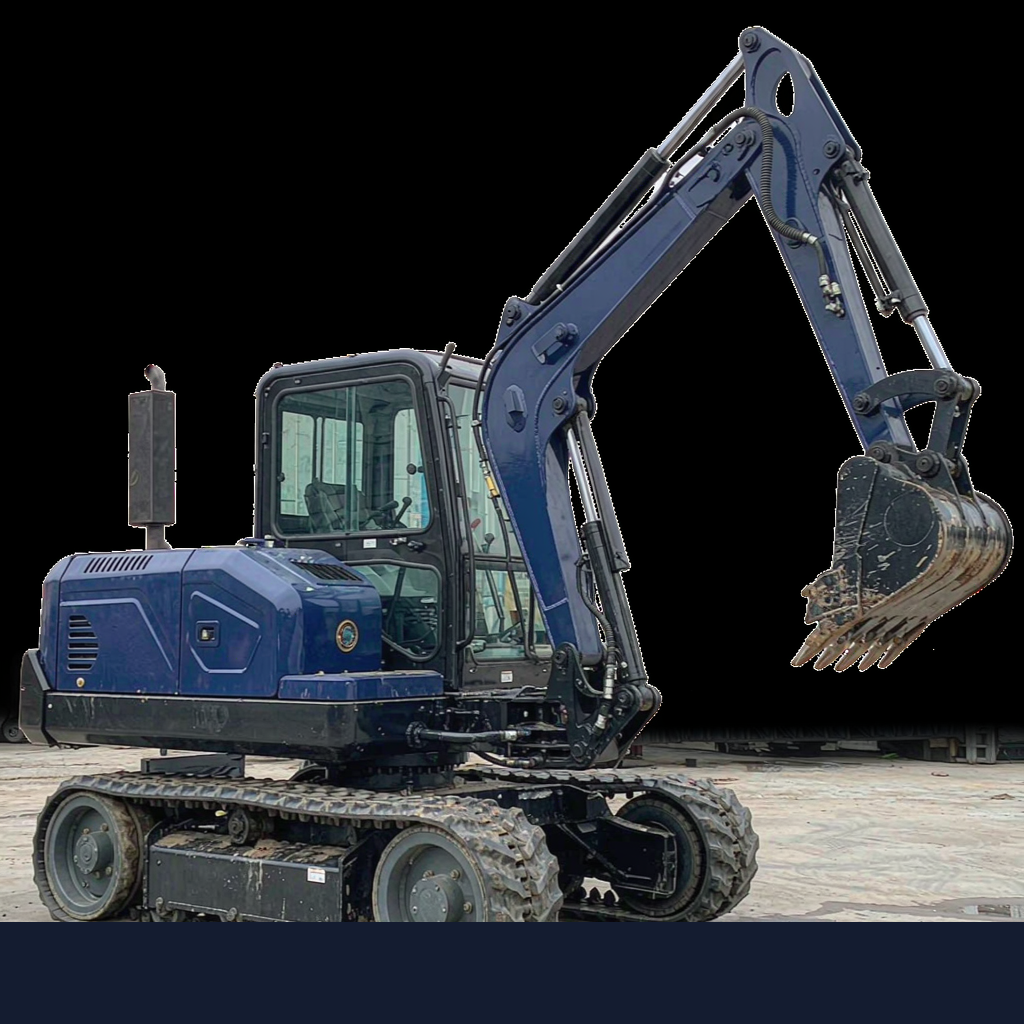
Zero-Tail vs Conventional Tail Swing: Which Mini Excavator Do You Actually Need?
If you are comparing mini excavators in the 1–3.5 ton class, one specification quietly separates two very different machines: tail swing. A zero-tail (zero-tail-swing) mini excavator rotates fully within the width of its own tracks, while a conventional-tail model swings its counterweight 300–500 mm beyond the track edge. On a 2-meter sidewalk next to live traffic, that difference decides whether the job is possible at all. This guide explains exactly how tail swing affects footprint, transport, stability, and price — and how to choose between a zero-tail model like the HL35U 3.5-ton zero-tail excavator and a conventional-tail unit such as the HL30 or HL22 series — before you commit to a supplier.
1. What “Zero Tail Swing” Actually Means (and What It Doesn’t)
Zero tail swing (ZTS) means the upper structure — counterweight included — never extends beyond the crawler track width during a full 360° rotation. It does not mean the machine is shorter or lighter; the counterweight is redesigned and lowered so it sweeps inside the tracks. In practice you get three consequences:
- Working footprint equals transport width. A 3.5-ton ZTS machine typically stays under 1,550–1,700 mm wide, so it can work against walls, hedges, fences, and curbs with no clearance margin.
- Operator confidence at height. On bridge decks, rooftops (craned in), and elevated slabs, there is no rear overhang to swing over edges or into barriers.
- Trade-off in counterweight leverage. Because the ballast is constrained, ZTS machines carry slightly less lift capacity at full radius and reach than an equal-weight conventional-tail machine. Typical loss: 8–15% at maximum working radius.
Conventional tail swing machines pay for their extra mass with better stability for heavy lifting and breakout work in open sites — utilities trenching, farm drainage, quarry yard work — where rear clearance is a non-issue.
2. Side-by-Side Specification Comparison
The table below compares representative models in LUYRN’s current excavator lineup. All figures are manufacturer specifications; confirm the current datasheet before ordering.
| Specification | HL35U (Zero Tail) | HL35 (Conventional) | HL26U (Zero Tail) | HL22 (Conventional) |
|---|---|---|---|---|
| Operating weight | 3,500 kg | 3,500 kg | 2,600 kg | 2,200 kg |
| Tail swing radius | 0 mm beyond tracks (ZTS) | ~1,420 mm | 0 mm beyond tracks (ZTS) | ~1,280 mm |
| Working width at 360° rotation | ≈ track width (≈1.6 m) | track width + ~1.4 m | ≈ track width (≈1.5 m) | track width + ~1.2 m |
| Max dig depth | ≈3.1 m | ≈3.2 m | ≈2.5 m | ≈2.5 m |
| Max reach at ground | ≈5.3 m | ≈5.5 m | ≈4.4 m | ≈4.5 m |
| Auxiliary hydraulic flow | Hammer/auger ready | Hammer/auger ready | Hammer/auger ready | Hammer/auger ready |
| Best fit | Urban streets, roadside, indoor demo | Open sites, utility trenching | Landscape, backyard access | Farm, drainage, general |
3. The Real Cost Difference: Rent Rate, Transport, and Damage Claims
The purchase price gap between a ZTS and a conventional-tail machine of the same tonnage is usually 3–7%. The TCO calculation is decided elsewhere:
- Damage liability. For rental fleets and contractors working urban streets, rear-swing contact with parked cars, storefronts, and scaffolding is a recurring claim category. One avoided claim typically offsets the ZTS price premium several times over.
- Transport. Both classes ship on a single-axle trailer behind a 5–7.5 ton truck. The ZTS’s tighter working width also matters on site: no second spotter needed when slewing near a wall.
- Resale. In markets with dense urban renovation work (Europe, Japan, coastal China, Middle East CBD districts), ZTS machines hold demand better in the 2–3.5 ton band; conventional tail retains an edge in agricultural regions.
4. Supplier Evaluation Checklist for ZTS Mini Excavators
Zero-tail designs concentrate stress in the slewing ring and counterweight mounting, so build quality questions differ from conventional machines. Before you wire a deposit, require:
| Check item | What to ask for | Red flag |
|---|---|---|
| Certification | CE declaration + ISO 9001 factory cert, not just “CE” on the nameplate | Scanned certificates without a notified-body number |
| Slewing bearing | Brand and rated life hours (ask for the bearing spec sheet) | “Standard bearing, no data” |
| Counterweight fixings | Bolted, inspectable castings — not welded hidden plates | Welded counterweight with no inspection access |
| Hydraulics | Named pump/valve brands, relief pressure in writing | “Imported brand” without a name |
| Spare parts | Guaranteed 5-year parts availability with lead times in days | Parts “same as factory” with no stock promise |
| Pre-shipment test | Video of 360° rotation with a fully loaded bucket at max radius | Test video of an empty machine only |
5. FAQ
Q: Is a zero-tail excavator less stable when lifting?
A: At maximum radius, yes — expect roughly 10% less lift capacity than a same-weight conventional-tail machine. For trench digging and standard attachment work the difference is negligible; for repeated heavy lifting at full reach, size up one class or choose conventional tail.
Q: Can a 3.5-ton zero-tail excavator fit through a residential gate?
A: Most HL35U-class ZTS machines are under 1.6 m wide, which clears a standard 90 cm–1.1 m gate only if the gate is removed or widened. Measure the tightest access point first — that number drives the tonnage choice, not the other way round.
Q: Does zero tail swing affect digging depth?
A: Not meaningfully. Dig depth in the 2.5–3.5 ton class is set by boom and arm geometry; ZTS and conventional models in the same weight class typically differ by 10–15 cm.
Q: Zero tail or short radius — are they the same thing?
A: No. “Short radius” machines still overhang the tracks by roughly half a counterweight width. True zero-tail (ZTS) means zero overhang. Always ask for the tail swing radius figure in millimetres, not the marketing label.
Q: What attachments work on a ZTS mini excavator?
A: Standard quick-hitch attachments — buckets, breakers, augers, grapples, rippers — are fully compatible, provided the carrier machine’s auxiliary flow matches the attachment requirement.
Get a Zero-Tail or Conventional Mini Excavator Quote
LUYRN supplies the full 1–26 ton excavator range, including the HL35U 3.5-ton zero-tail, HL26U 2.6-ton zero-tail, HL10–HL35 mini crawler series, and HL65–HL260 production-class machines — all with CE documentation and OEM/ODM configuration. Send your site constraints (access width, dig depth, attachments) and target market to info@luyrn.com and we will recommend the right tail-swing configuration with a complete quotation and pre-shipment test video.