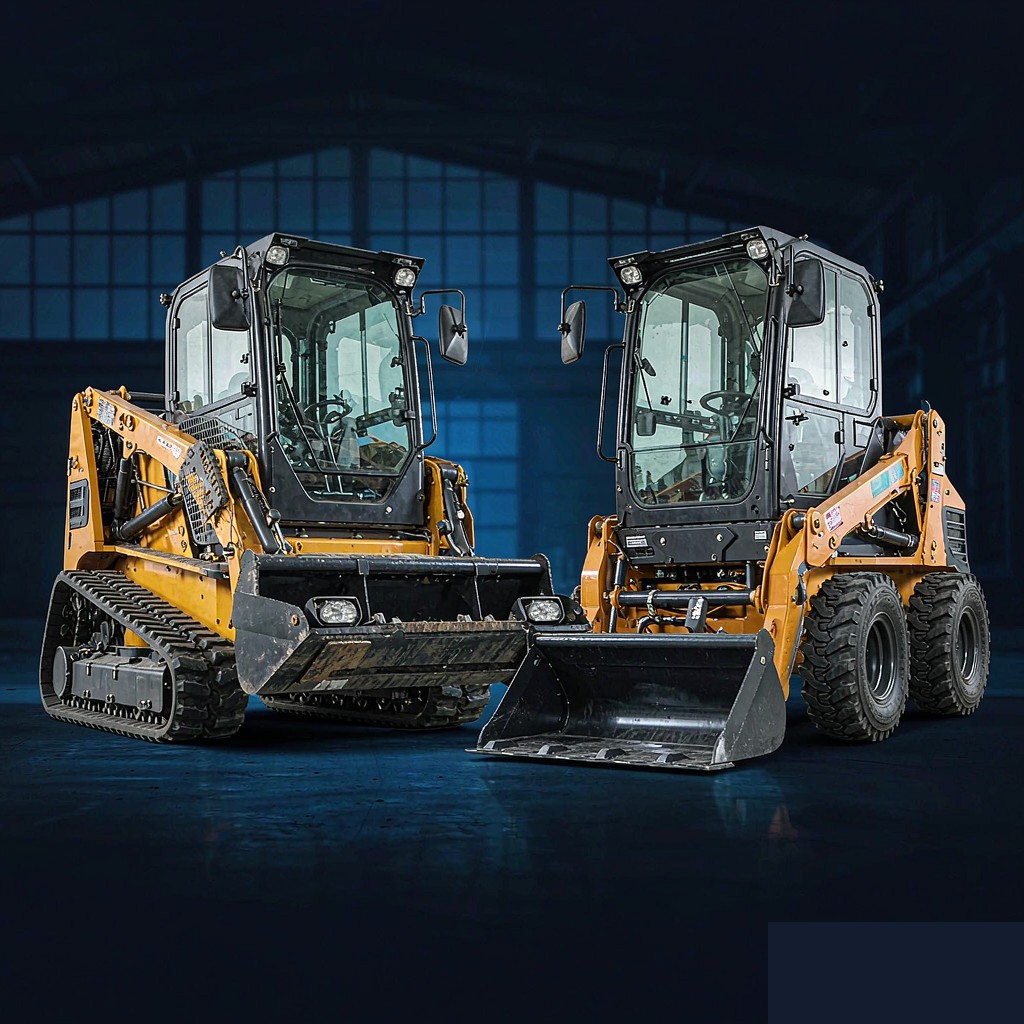
Choosing between a wheeled skid steer loader and a tracked (crawler) skid steer comes down to three variables: the ground you work on, the hours you run, and how you value speed against traction. On hard, dry, level surfaces a wheeled machine is 20–40% faster in travel and roughly 15–25% cheaper to buy and maintain. On mud, sand, snow, or freshly graded soft soil, a tracked machine keeps working where wheeled units sink — because rubber tracks spread the same weight over roughly one-third of the ground pressure.
This guide compares both undercarriages with real numbers — ground pressure, replacement intervals, five-year cost — and maps them onto the three skid steer configurations LUYRN currently supplies to B2B buyers: the LUY-SSL-080 8-ton wheeled skid steer, the HL65 6.5-ton crawler skid steer, and the LUY-SSL-035 3.5-ton compact crawler.
Wheels or Tracks? The 30-Second Decision
If you only read one section, read this one. Industry buying data from equipment dealers and fleet managers is remarkably consistent on where each undercarriage wins:
- Choose a wheeled skid steer if your sites are concrete, asphalt, compacted gravel, or dry firm soil; you travel between sites on roads; you run high-cycle loading where travel speed matters; or your budget prioritizes the lowest purchase price and cheapest wear parts.
- Choose a tracked (crawler) skid steer if your ground is soft, wet, sandy, or uneven; you work on turf or finished surfaces that must not be torn up; you push into slopes above roughly 10 degrees; or losing productive hours to stuck machines costs more than the higher undercarriage budget.
Neither configuration is universally better. The wrong answer is expensive in both directions: a wheeled machine on spring mud loses days to recovery and rutted ground, while a tracked machine on paved yard duty burns through expensive rubber for no benefit.
Ground Pressure: The Number That Decides Everything
Ground pressure — the machine’s weight divided by its contact area — determines whether you float or sink. It is the single most important specification in this comparison:
| Machine Type | Typical Ground Pressure | Practical Meaning |
|---|---|---|
| Crawler / tracked skid steer | 3–6 PSI (0.28–0.35 kg/cm²) | Lighter than a person walking; works on mud, sand, snow, and turf |
| Wheeled skid steer (wide tires) | 8–14 PSI (0.45–0.60 kg/cm²) | Handle firm, dry, compacted ground without rutting |
| Wheeled skid steer (narrow industrial tires, loaded) | 25–35+ PSI | Sinks in soft soil; tears turf; leaves ruts after rain |
A tracked machine carries roughly 50–80% more traction on loose and wet surfaces because the full track length grips continuously, while a wheeled unit only loads four tire patches. That traction converts directly into pushing force when back-blading, grading, or loading a truck parked on soft ground.
Speed and Cycle Times: Where Wheels Earn Their Keep
On hard surfaces the physics reverse. Wheeled skid steers travel at up to 18 km/h versus 8–13 km/h for tracked units — a 20–40% advantage that compounds over a shift of short-cycle loading, stockpiling, or yard cleanup. Three more reasons fleets keep wheeled machines on paved duty:
- Lower fuel per hour. Less rolling resistance on firm ground means the engine works less to cover the same distance.
- No pavement damage from pivoting. Tracked machines scuff and mark finished concrete and asphalt when they turn; wheeled skid steers with proper tires are gentler on the surfaces they are fastest on.
- Simpler drivetrain. No rollers, idlers, or drive sprockets — fewer components to inspect, lubricate, and rebuild.
Rocky, abrasive ground is the one surface where wheels also beat tracks on cost: sharp aggregate chews rubber track lugs quickly, and tire replacement on abrasive sites is far cheaper than track replacement.
The Five-Year Cost Gap: Tires vs. Tracks
Tracked skid steers typically cost 15–25% more upfront than a comparable wheeled unit. The bigger difference shows up in wear parts over a five-year, 4,000–5,000-hour ownership window:
| Cost Factor | Wheeled Skid Steer | Tracked / Crawler Skid Steer |
|---|---|---|
| Purchase price (comparable class) | Baseline | +15–25% |
| Ground contact wear parts | 4 tires: $600–$1,200 per set | Rubber tracks: $3,000–$6,000 per set |
| Typical replacement interval | Tires ~1,000–1,500 h | Tracks ~1,200–2,500 h (soft dirt 2,500+; rocky/abrasive 1,200–1,500) |
| Undercarriage rebuild (~2,000 h) | Not required | Rollers, idlers, sprockets — materially higher cost |
| Annual maintenance trend | Lower — fewer wear components | Higher — more inspection points |
Run the math for a realistic 1,000-hour year: a wheeled machine consumes roughly one tire set annually at $600–$1,200, while a tracked machine averages $1,500–$3,000 per year in track and undercarriage amortization on mixed surfaces. Over five years that is a $5,000–$10,000 gap before the higher purchase price is even counted. Tracked machines claw some of it back in productivity on soft ground — fewer stuck-machine recoveries, fewer re-dos of rutted work — which is exactly why the decision must start with your ground conditions, not the price list.
Matching the Undercarriage to Your Job Site
Map your dominant surfaces against these verified use cases:
- Material yards, warehouses, batch plants, urban logistics: wheeled. Flat, hard floors are where wheeled skid steers deliver their lowest cost per hour and fastest cycles.
- Landscaping, turf, and finished-grade work: tracked. At 3–6 PSI a crawler leaves less mark than a wheelbarrow; at 8–14+ PSI a wheeled unit reseeds the lawn instead of finishing it.
- Agriculture, pipeline, and sand/desert sites: tracked. Soft, loose, or seasonally wet ground is where tracks float and tires bog down.
- Slope work above ~10 degrees: tracked. The longer contact patch gives meaningfully better grip and stability on grades where wheeled units slide.
- Demolition and recycling: wheeled with puncture-resistant or foam-filled tires. Steel debris and abrasive concrete destroy track rubber.
- Snow removal: tracked in deep or wet snow; wheeled works on cleared pavement and in low-accumulation regions.
LUYRN Wheeled and Crawler Skid Steers: 2026 Spec Comparison
LUYRN currently supplies three skid steer configurations covering both undercarriage types, with CE marking and factory-documented quality control for export buyers:
| Specification | LUY-SSL-080 8-Ton Wheel | HL65 6.5-Ton Crawler | LUY-SSL-035 3.5-Ton Crawler |
|---|---|---|---|
| Undercarriage | Wheeled, 4WD | Rubber crawler | Rubber crawler |
| Operating weight | 8,000 kg | 6,500 kg | 3,500 kg class |
| Rated load | Heavy-duty loading duty | 2,000 kg | Compact-duty loading |
| Engine | Diesel | Changchai 4-cylinder, 36.8 kW | Diesel |
| Max lifting height | Full-height yard loading | 3,800 mm | Compact-frame reach |
| Steering / controls | Articulated steering | Skid-steer | Pilot hydraulic controls |
| Best ground | Flat, hard, dry surfaces | Soft, uneven, muddy sites | Tight sites, mud and gravel |
How the three fit real fleets: the LUY-SSL-080 is the yard and transfer-station workhorse — fast travel, 4WD, and articulated steering for flat-ground material handling and truck loading. The HL65 crawler is the mid-size tracked unit for construction sites where grading, material handling, and loading happen on soft or uneven ground, with a rated load of 2,000 kg and 3,800 mm lift height. The LUY-SSL-035 compresses the same crawler traction into a compact frame with pilot hydraulic controls for confined sites — landscaping, indoor demolition, and narrow urban access where a 6.5-ton machine cannot maneuver.
Why Many B2B Fleets Buy Both
Municipal and landfill fleet data shows the most common 2026 configuration is a mixed fleet: roughly 70–80% wheeled units for bulk daily work on firm ground, plus one or two crawlers staged for wet zones, slopes, and soft-cell work. Distributors serving mixed-demand regions follow the same logic when stocking: wheeled units turn faster at the right price point, while crawler stock differentiates them for landscaping, agricultural, and soft-ground buyers. If your operation crosses both surface types — say, a site-development contractor moving from cleared pads to ungraded perimeters — two correctly specified machines almost always beat one compromised machine.
Buying Checklist for Import Buyers
Undercarriage choice is one decision in a full procurement process. Before committing to either configuration, confirm:
- ROC (rated operating capacity) matches your heaviest routine attachment plus load — see the full skid steer loader procurement guide for the ROC and quick-hitch checklist.
- Engine emissions compliance for your destination market (Tier 4 Final / Stage V where required).
- Attachment coupler standard — both wheeled and crawler units should run the same quick-coupler so one attachment inventory covers the fleet.
- Spare wear parts in the container: an extra set of tires or a track pair alongside the machine typically costs a fraction of later air-freight.
- Export packaging and CE/ISO documentation — LUYRN ships worldwide with protective export packing; compare against the wheel loader procurement guide if you also need higher-volume loading.
For buyers pairing loaders with digging capacity, the crawler excavator buying guide (6.5–26 ton) covers the next size class up, and the road roller procurement guide completes a compaction-plus-handling equipment package.
Frequently Asked Questions
Which is better: a wheeled or tracked skid steer loader?
Neither is universally better — ground conditions decide. Wheeled skid steers win on concrete, asphalt, and compacted gravel with 20–40% faster travel and lower running costs. Tracked (crawler) skid steers win on mud, sand, snow, turf, and slopes above ~10 degrees, with 3–6 PSI ground pressure versus 8–35 PSI for wheels.
How long do skid steer tracks last compared to tires?
Industry benchmarks put rubber tracks at roughly 1,200–2,500 hours depending on surface — soft dirt can exceed 2,500 hours, while rocky or abrasive ground wears them out in 1,200–1,500 hours. Tires last about 1,000–1,500 hours but cost $600–$1,200 per set versus $3,000–$6,000 for a track set, so wheels remain cheaper per hour on abrasive sites.
Can I add over-the-tire tracks to a wheeled skid steer instead of buying a crawler?
Over-the-tire (OTT) tracks exist and improve soft-ground traction, but they add weight, reduce travel speed, accelerate tire wear, and still do not match the ground pressure or ride of a purpose-built crawler undercarriage. For operations that regularly work soft ground, a dedicated tracked machine is the more durable investment; OTT tracks suit occasional seasonal use.
Do tracked skid steers hold resale value better than wheeled ones?
Both configurations sell in the same 40–55% range of original price for 2020–2023 machines at 2,000–3,500 hours, but tracked unit resale depends heavily on undercarriage condition. Buyers inspect track depth, roller and sprocket wear closely — a crawler with a worn undercarriage near its ~2,000-hour rebuild point prices at a steep discount, while documented maintenance protects value in both configurations.
Get Spec Sheets and FOB Quotes from LUYRN
LUYRN supplies the LUY-SSL-080 wheeled skid steer, the HL65 6.5-ton crawler, and the LUY-SSL-035 compact crawler with CE/ISO documentation, factory-documented quality control, protective export packing, and worldwide shipping. Send us your ground conditions, rated-load requirement, and destination port, and we will recommend the right undercarriage and configuration — reference pricing is customizable to your spec.
Email info@luyrn.com with your duty cycle and site conditions for a same-week spec sheet and FOB quotation, or browse the complete wheeled and crawler skid steer listings for full specifications.