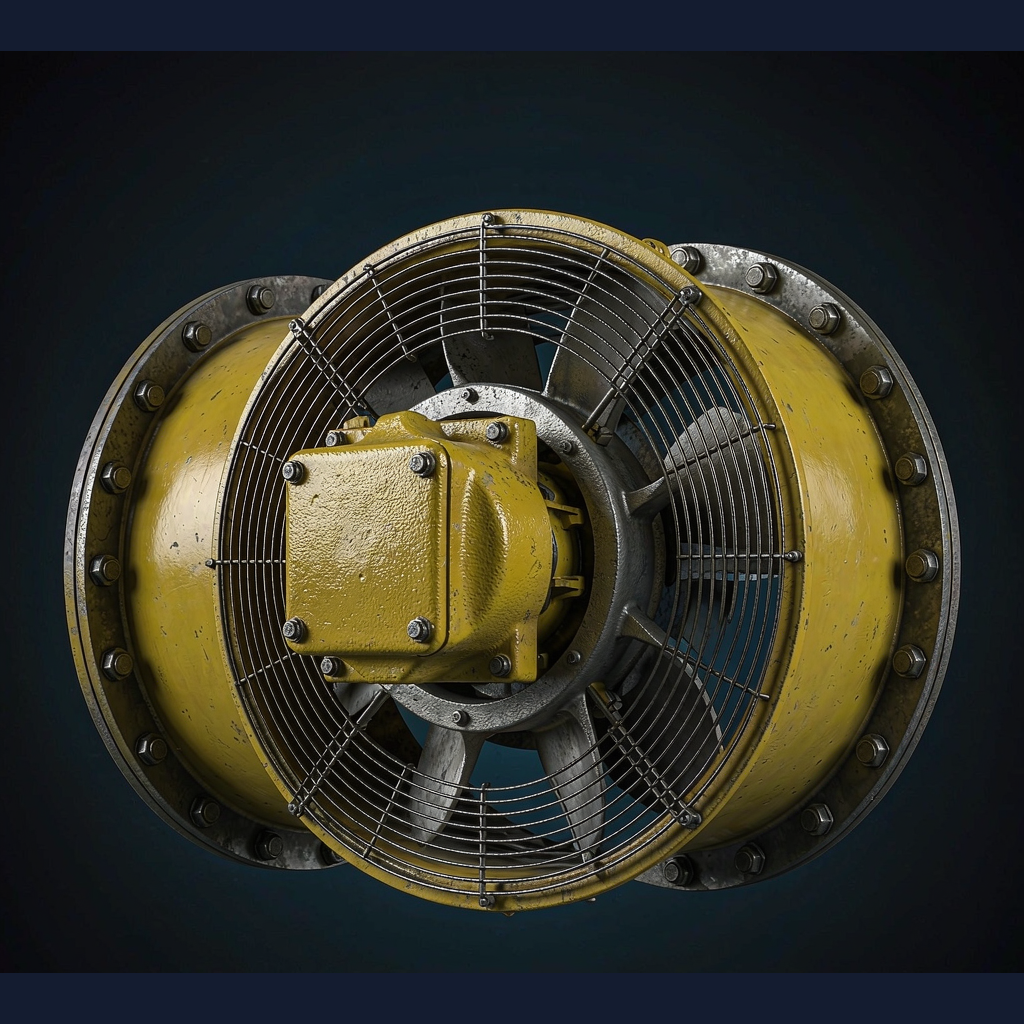
Why Explosion-Proof Axial Fans Decide Mine Safety (and Compliance)
Underground and enclosed mine sites live or die by ventilation. The fan you install is not a comfort item — it is the machine that dilutes methane, clears diesel particulate, and keeps your operation inside the air-quality limits enforced by ISO 6184-1 and GB 3836 (Ex d I Mb) certification regimes. Buying the wrong fan means failed inspections, production stoppages, and — in the worst case — an ignition risk in a gassy seam. This guide walks B2B buyers through the 2026 procurement landscape for explosion-proof mine axial fans: how to size airflow, which certifications actually matter, how to evaluate a supplier, and what total cost of ownership looks like over a 10-year service life. At LUYRN, the explosion-proof mine axial fan we supply is CE-marked, Ex-certified, and built for continuous duty in coal and non-coal underground operations — and the checks below are exactly what our engineering team walks through with importers before quoting.
Step 1: Size the Fan to Your Airflow Requirement — Not the Other Way Around
The most common procurement mistake we see is buying a fan by motor kW instead of by required airflow. Reverse-engineering airflow from a nameplate wastes budget and can leave your workings under-ventilated. Work the calculation in this order:
- Determine required air volume (Q): based on the number of diesel units underground (commonly 4–6 m³/min per kW of diesel equipment), methane emission rate of the seam, and the maximum number of personnel per shift.
- Compute total resistance (R): duct length, bends, and leakage all add pressure loss. Auxiliary ventilation in a 500 m heading with 800 mm ducting typically needs 1,500–3,000 Pa of static pressure capability.
- Match the fan curve: an axial fan delivers high flow at low pressure; for long duct runs above ~800 m, consider series (two fans in line) arrangements or step up to a higher-pressure stage.
- Leave 15–20% margin for duct aging and leakage, but do not oversize beyond that — an oversized fan running against a closed damper wastes energy and can recirculate contaminated air.
| Application | Typical Airflow | Typical Static Pressure | Suggested Fan Class |
|---|---|---|---|
| Driveage < 300 m, 1–2 small units | 150–300 m³/min | 500–1,200 Pa | Single-stage axial, 5.5–11 kW |
| Driveage 300–800 m, multiple diesels | 300–600 m³/min | 1,200–2,500 Pa | Single-stage axial, 15–30 kW |
| Long heading > 800 m / gassy seam | 600–1,000+ m³/min | 2,500–4,500 Pa | Two-stage axial or series arrangement, 30–55 kW |
| Main shaft / decline ventilation | 1,000–5,000 m³/min | Site-specific | Main fan station (engineered design) |
Ask every shortlisted supplier for the full fan performance curve at your site’s air density — not just a peak-flow number on a datasheet.
Step 2: Certifications That Actually Matter in 2026
“Explosion-proof” is a claim, not a standard. Verify these before wiring any deposit:
- Ex certification to IEC 60079 / GB 3836 (Ex d I Mb): the flameproof enclosure rating specifically for methane group I mining environments. Ask for the certificate number and verify it on the issuing body’s database.
- MA / KA mining product safety mark (China): mandatory for fans used in Chinese coal mines and a strong quality signal for export units built on the same platform.
- CE marking with the applicable directives: Machinery Directive, ATEX where relevant for the destination market, and EMC.
- ISO 9001 manufacturing certification at the factory level — fans are welded, dynamically balanced assemblies; process control shows up in vibration life.
Practical tip: request photos of the nameplate on the actual production unit, not a brochure. The Ex marking (e.g., Ex d I Mb) must be die-stamped or permanently marked on the enclosure.
Step 3: Supplier Evaluation Checklist for Importers
If you are importing fans from China for a mining distributorship or an EPC project, score suppliers on these criteria before signing:
| Criterion | What to Verify | Red Flag |
|---|---|---|
| Ex certificate authenticity | Certificate number traceable on issuer database; covers your exact model | “Certificate in application” or cert for a different frame size |
| Impeller manufacturing | Casted or welded aluminum/magnesium alloy (non-sparking), dynamic balancing report included | No balance report; steel impellers in gas-group-I fans |
| Motor source | Flameproof motor from a named, certified motor plant | Unbranded motor with no Ex certificate of its own |
| Performance testing | Site-testable performance curve; witness test or video test per order | Only brochure curves, no per-order test |
| Spare parts & documentation | Impeller, bearings, terminal boxes available; IEC 60079-19 repair guidance in manual | No parts commitment — underground fans need impeller spares on site |
For a first order, buy one unit as a sample with a witnessed performance and insulation-resistance test, then scale to container quantities. LUYRN supports sample orders of our explosion-proof mine axial fan with full test reports, CE/Ex documentation, and OEM branding for distributors.
Step 4: Total Cost of Ownership Over 10 Years
Acquisition price is typically only 30–40% of a mine axial fan’s lifetime cost. Model these items when comparing quotes:
- Energy: a 30 kW fan running 6,000 h/year consumes ~180 MWh annually. A 10% efficiency difference between suppliers is worth more than the fan’s purchase price within two years.
- Impeller and bearing overhaul: expect impeller replacement or re-balancing every 3–5 years depending on dust load; budget the spare impeller at purchase time.
- Downtime risk: a failed primary or auxiliary fan stops the whole section. Dual-fan (duty/standby) arrangements on critical headings are cheap insurance.
- Compliance risk: an uncertified unit discovered at audit means removal, repurchase, and possible fines — the single most expensive “saving” in this category.
When you normalize all four, a mid-range certified fan from a verified factory almost always beats the cheapest quote.
FAQ: Explosion-Proof Mine Axial Fan Procurement
Q1: Can I use a standard industrial axial fan with an Ex-rated motor instead of a fully certified mine fan?
A: No. For methane group I (mining) environments, the complete assembly — enclosure, impeller, terminal box, and cooling arrangement — must carry the Ex d I Mb marking. A standard fan body with an Ex motor is not compliant.
Q2: Axial or centrifugal for underground auxiliary ventilation?
A: Axial fans dominate auxiliary ventilation because they mount inline with ducting and deliver the high flow needed at moderate pressures. Centrifugal units appear mainly at main fan stations with high static pressure demands.
Q3: What maintenance interval should our crew plan for?
A: Daily visual checks (vibration, noise, temperature), bearing lubrication per the OEM schedule (typically every 2,000–4,000 h), impeller inspection and cleaning every 6 months, and a full dynamic-balance check annually or after any impeller repair.
Q4: What documents should ship with every fan?
A: Ex certificate, CE declaration of conformity, performance test report, dynamic balancing report, wiring/terminal diagrams per IEC 60079-14, and the installation & maintenance manual. Refuse delivery without the full pack.
Q5: What is a typical lead time for export orders?
A: Sample units generally ship in 2–4 weeks; full container orders in 5–8 weeks including crate packing and documentation, depending on frame size and motor certification stock.
Get a Certified Fan Quote from LUYRN
LUYRN supplies the explosion-proof mine axial fan (CE OEM) alongside a full range of mining and industrial machinery for B2B importers, mining contractors, and EPC projects. Send your required airflow, duct length, and destination port to info@luyrn.com and our team will come back within 24 hours with a matched fan model, performance curve, and an itemized quote including spares and documentation.