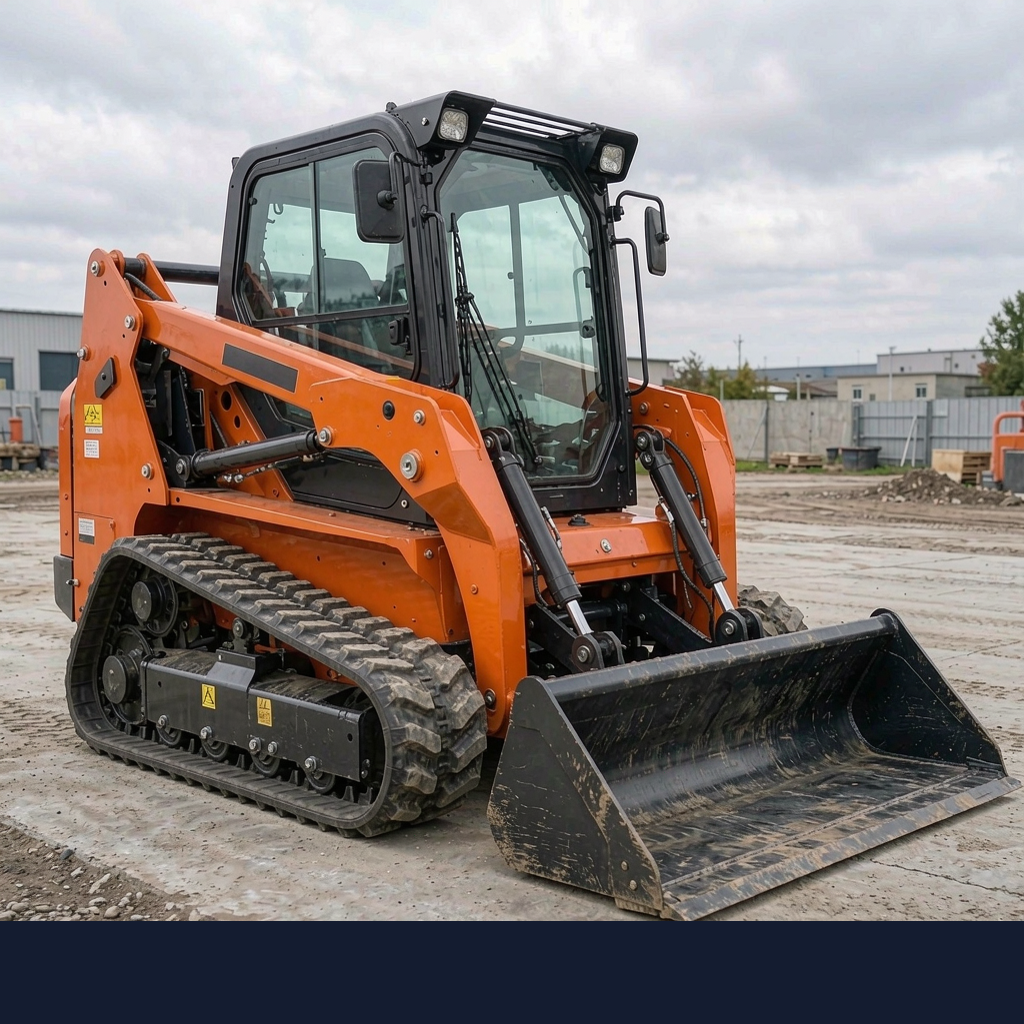
What Is a Crawler Skid Steer Loader and Who Should Buy One?
A crawler skid steer loader — often called a compact track loader (CTL) — replaces the wheels of a traditional skid steer with steel-reinforced rubber tracks, cutting ground pressure roughly in half and multiplying traction on mud, sand, and loose gravel. If your jobsites include soft farmland, wet excavation backfill, demolition debris, or slopes, a tracked machine will outperform a wheeled unit where wheeled loaders stall, spin, and rut the ground. If you mostly work on paved or compacted surfaces and relocate between sites daily on a trailer, a wheeled skid steer is still cheaper to run. LUYRN currently supplies three in-stock models in this class: the HL65 6.5-ton crawler skid steer, the 3.5-ton crawler skid steer loader, and the 8-ton wheel skid steer loader for buyers who need heavier wheeled capacity — all CE certified and OEM-configurable.
This guide answers the three questions B2B buyers actually ask before wiring a deposit: which size to buy, what specs and compliance documents to verify, and how the total cost of ownership compares against wheeled units over a five-year fleet life.
Crawler vs. Wheeled: The 2026 Decision Matrix
The core trade-off is ground pressure versus operating cost. Tracks distribute weight over a larger contact patch (typ. 25–35 kPa ground pressure vs. 45–60 kPa for wheeled), which matters most in these scenarios:
| Work Condition | Recommended Configuration | Why |
|---|---|---|
| Soft farmland, wet clay, rice paddies | Crawler (3.5–6.5 t) | Ground pressure ~50% lower; no ruts or getting stuck |
| Snow removal, municipal winter service | Crawler or wheeled + snow kit | Tracks hold slope and ice better |
| Paved yards, warehouse logistics | Wheeled (8 t class) | No track wear on concrete; faster travel, ~10–12 km/h |
| Demolition, rock, scrap handling | Crawler, steel-reinforced undercarriage | Tracks absorb impact; wheeled tires puncture |
| Forestry, slope mowing >15° | Crawler only | Track traction on grades up to ~30° |
| Multiple short urban hops per day | Wheeled | Trailers only needed for crawlers; tires cheaper than track chains |
Rule of thumb: if more than 30% of your operating hours are on soft or uneven ground, the crawler pays for its higher undercarriage cost within the first year through uptime alone.
Which Size? Matching the Three LUYRN Models to Your Fleet
Rated operating capacity (ROC) — not machine weight — is the number that determines what your machine can actually lift and carry safely (typically 50% of tipping load). Oversizing wastes fuel and shipping cost; undersizing forces slow, double-handled cycles.
| Model | Operating Weight | Best-Fit Applications | Typical Attachments |
|---|---|---|---|
| 3.5-Ton Crawler Skid Steer | ~3,500 kg | Landscaping, small farms, indoor demolition, greenhouse work, narrow residential lots | Standard bucket, auger, trencher, pallet forks, mulcher (low-flow) |
| HL65 6.5-Ton Crawler Skid Steer | ~6,500 kg | Construction site prep, roadworks, material handling for mid-size civil projects, snow clearing | 4-in-1 bucket, hydraulic breaker, cold planer, grapple, high-flow attachments |
| 8-Ton Wheel Skid Steer | ~8,000 kg | Ports, stockyards, paved industrial sites, high-cycle loading where speed matters | Large-capacity bucket, forks, sweeper, bale spear |
Two spec checks buyers frequently skip:
- Auxiliary hydraulic flow. Standard-flow systems (60–80 L/min) run augers and brooms; high-flow (110–140 L/min) is required for cold planers, mulchers, and most breakers. Confirm the pump option before ordering — retrofitting later is expensive.
- Lift path. Radial lift gives best mid-range reach for digging and loading; vertical lift gives higher lift height and better truck loading. For 6.5-ton machines doing truck loading, prefer vertical lift geometry.
Compliance and Documentation Checklist for Import Buyers
For CE-market and most B2B tenders, request these documents from any supplier before placing an order:
- CE Declaration of Conformity covering the Machinery Directive 2006/42/EC, with the certificate issued for the actual model, not a “similar” unit.
- ROPS/FOPS cab certificate (ISO 3471 / ISO 3449) — non-negotiable if operators work near embankments or demolition zones.
- Emissions stage compliance: Tier 4 Final / Stage V engine documentation for EU and North America; many African, Middle East, and Southeast Asian markets still accept Tier 2/3 engines, which cut purchase price by 8–15%.
- ISO 9001 factory certificate and pre-shipment inspection (PSI) report — LUYRN supports third-party inspection (SGS/BV/TÜV) before container loading at no commercial obstruction.
- Spare parts list and hydraulic schematics in English. A supplier that cannot produce these on request is a red flag for after-sales support.
All three LUYRN models ship CE-marked with OEM options, and our export team prepares the full document pack — commercial invoice, packing list, CoC, and HS-code classification — with each shipment.
Total Cost of Ownership: A 5-Year Reality Check
Tracked machines cost more upfront and more per hour to maintain, but they win on utilization where wheels fail. Indicative numbers for a 2,000-hour-per-year fleet unit:
| Cost Item (5 years / 10,000 h) | Wheeled 8 t | Crawler 6.5 t |
|---|---|---|
| Acquisition (FOB, indicative) | Baseline | +10–18% |
| Tire replacement | 2–3 sets | None |
| Track replacement | None | 1–2 sets (~every 3,500–5,000 h) |
| Downtime on soft ground | High (recovery, ruts, rework) | Minimal |
| Resale value at 10,000 h | ~35–40% of purchase | ~30–35% (undercarriage condition dependent) |
The biggest controllable cost on a CTL is undercarriage life. Three habits extend track life by 30% or more: keep track tension at the manufacturer’s sag spec (check weekly), avoid repeated full-speed counter-rotation turns on abrasive surfaces, and wash out packed mud/debris from the undercarriage at the end of each shift. When comparing supplier quotes, always ask for track chain brand (e.g., rubber track supplier and steel cord spec) — this single line item explains most price gaps between “identical” quotes.
Frequently Asked Questions
Is a crawler skid steer loader worth the extra cost over a wheeled model?
If your ground is soft, uneven, or sloped for even a third of your operating hours, yes — utilization gains and zero rutting/rework typically recover the price premium within 12 months. On hard paved surfaces, a wheeled unit like the 8-ton model is the more economical choice.
How long do rubber tracks last?
With correct tension and no abrasive abuse, expect 3,500–5,000 hours. Rock quarries and demolition scrap can cut this to 2,000 hours. Always confirm track brand and warranty coverage (reputable suppliers offer 12 months or 2,000 hours).
Can I use my existing skid steer attachments?
Most modern machines use the universal ISO 3204 quick-attach (Bobcat-style) interface, so buckets, forks, and augers transfer directly. High-flow attachments require the machine’s high-flow hydraulic option — verify flow and pressure ratings before ordering.
What is the lead time for export orders?
Standard configuration units typically ship in 15–25 days; OEM color, engine, and attachment configurations add 10–15 days. LUYRN holds in-stock units of all three models for fast container consolidation.
Do you support mixed-container orders?
Yes. Many fleet buyers consolidate a crawler skid steer with a mini excavator or forklift in one 40ft container — contact info@luyrn.com with your target list and destination port for a consolidated quote.
Get a Same-Week Quote
LUYRN supplies CE-certified crawler and wheeled skid steer loaders, excavators, forklifts, and farm tractors to B2B buyers in 40+ countries, with OEM branding, full export documentation, and pre-shipment inspection support. Send your specification and destination port to info@luyrn.com and our export engineers will respond within one business day with pricing, lead time, and configuration options.